
The global industrial sector is currently navigating an unprecedented era of transformation, characterized by the convergence of high-performance computing, advanced robotics, and sophisticated artificial intelligence (AI). This transition, often described as the evolution from Industry 4.0 to Industry 5.0, marks a fundamental shift from purely digital and connected systems to human-centric, resilient, and sustainable manufacturing ecosystems. As of early 2026, the industrial landscape is defined by the “Physical World Upgrade,” a massive hardware and software cycle where AI moves from centralized cloud environments to the edge, enabling real-time perception and autonomous action. This report examines the technical mechanisms, strategic imperatives, and systemic challenges of AI in industrial automation, drawing on extensive research from 2025 and 2026.
The Socio-Technical Transition: From Industry 4.0 to Industry 5.0
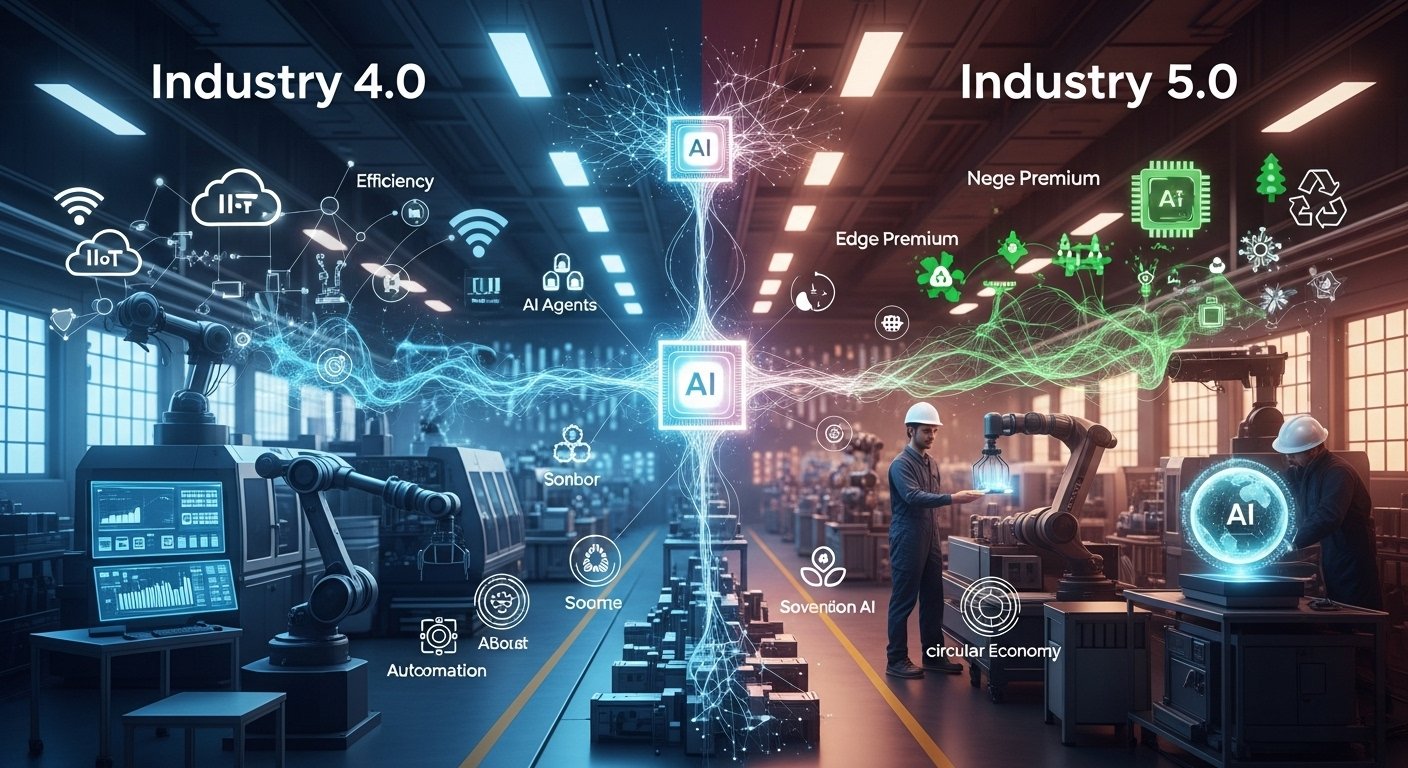
For the past decade, Industry 4.0 focused on the digitization of manufacturing through the Industrial Internet of Things (IIoT), cyber-physical systems, and data-driven optimization. However, the limitations of this paradigm—specifically its focus on efficiency at the expense of human agency and environmental resilience—have led to the emergence of Industry 5.0. This new era does not replace the connectivity of Industry 4.0 but rather redirects its technological power toward a symbiosis between human creativity and machine precision.
The transition is necessitated by several macroeconomic pressures, including global trade volatility, severe labor shortages, and the urgent requirement to meet Sustainable Development Goals (SDGs), particularly SDG 12 regarding responsible consumption and production. Research indicates that organizations adopting the Industry 5.0 framework prioritize resilience over lean efficiency, recognizing that absolute optimization often creates fragile supply chains. The market for Industry 5.0 technologies is projected to reach approximately USD 312.24 billion by 2030, driven by a compound annual growth rate (CAGR) of nearly 30% from 2025.
| Feature | Industry 4.0 | Industry 5.0 |
| Primary Objective | Connectivity and Efficiency | Resilience and Human-Centricity |
| Technological Core | Cyber-Physical Systems and IoT | AI Agents and Collaborative Robotics |
| Workforce Strategy | Automation of repetitive tasks | Augmentation of human expertise |
| Sustainability | Waste reduction through precision | Circular economy and green energy |
| Data Architecture | Centralized Cloud/Data Lakes | Decentralized Edge/Sovereign AI |
The narrative of Industry 5.0 is deeply rooted in the idea of “Twin Transitions”—the simultaneous move toward a climate-neutral and digitally competitive industrial base. This dual focus ensures that technological breakthroughs in AI do not just increase output but also reduce the carbon footprint and resource intensity of manufacturing processes.
Core AI Technologies and Their Industrial Mechanisms
The current industrial revolution is powered by a diverse array of AI technologies, each addressing specific operational needs. These range from established machine learning (ML) algorithms to the emerging frontiers of generative and agentic AI.
Generative AI and Design Innovation
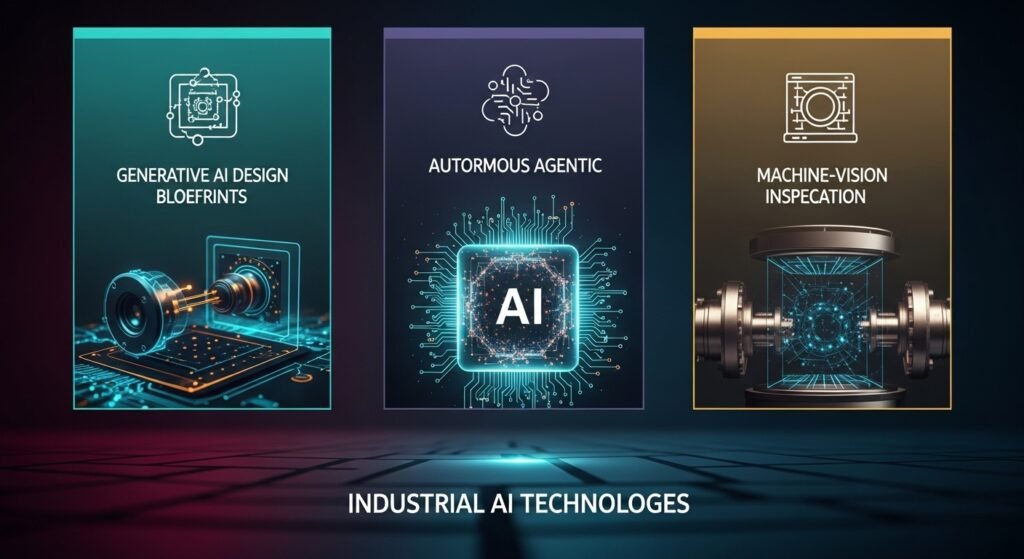
Generative AI (GenAI) has moved beyond text generation to become a critical tool for industrial design and workflow optimization. In manufacturing, generative design involves algorithms that create optimized product architectures based on specific constraints such as material properties, weight limits, and cost targets. These systems can explore design spaces beyond human imagination, suggesting alternatives that optimize for strength-to-weight ratios or manufacturability.
Furthermore, GenAI is being utilized to generate synthetic data for training other AI models. For example, developers are using generative audio models to create thousands of variations of rare events, such as glass breaking or motor bearing failure, to train sensors without needing to physically damage equipment. This “synthetic training” accelerates the deployment of predictive maintenance systems by months.
The Emergence of Agentic AI
The year 2026 marks the widespread adoption of agentic AI—autonomous systems capable of reasoning, planning, and executing multi-step tasks with minimal human intervention. Unlike traditional “copilots” that require constant prompting, AI agents act as digital collaborators that can interpret real-time data from the factory floor, access enterprise systems (ERP/MES), and implement changes independently.
In supply chain planning, these agents serve as “co-planners,” anticipating demand shifts and automatically recalibrating production schedules or reallocating materials. Pilots in the food and beverage industry have demonstrated that agentic AI can reduce delivery times by 30% and fuel costs by 12% through real-time route and load optimization.
Machine Learning and Computer Vision
Machine learning remains the foundational technology for 69% of industrial AI applications, focusing on pattern recognition and anomaly detection. Computer vision, a subfield of ML, has evolved through the use of deep learning and neural networks to enable automated quality inspection at speeds impossible for humans. Embedded vision systems in assembly lines can now detect microscopic defects—such as scratches on a semiconductor wafer or misalignments in an automotive chassis—with over 95% accuracy. These systems process visual data locally at the edge, avoiding the latency and costs associated with cloud-based analysis.
The Hardware Inflection Point: Edge Intelligence and Sovereign AI
The transition of AI from the cloud to the edge is driven by both physics and economics. As the number of connected industrial endpoints is projected to reach 41.6 billion by 2025, the volume of data generated is too massive to stream continuously to centralized servers. Consequently, 75% of data processing is expected to occur at the edge by the end of 2025.
Neural Processing Units and Neuromorphic Computing
To support high-speed inference in power-constrained environments, manufacturers are deploying specialized silicon. Neural Processing Units (NPUs) and Application-Specific Integrated Circuits (ASICs) are designed specifically for ML workloads, consuming up to 20 times less power than traditional GPUs. A prominent example is the STM32 N6 microcontroller, which can run object detection at 15 frames per second (FPS) while maintaining ultra-low power consumption.
Neuromorphic computing represents the next frontier in hardware. These chips mimic the human brain’s architecture, processing data in “spikes” and consuming milliwatts instead of watts. For industrial applications in “hard-to-reach” locations—such as remote mining equipment or deep-sea pipelines—neuromorphic chips enable long-term monitoring on battery power, providing 90% energy reductions compared to traditional edge deployments.
Market Evolution and Processor Trends

The edge AI hardware market is experiencing a rapid upgrade cycle. While GPUs held a dominant 50.12% market share in 2025 due to their mature software stacks, ASICs and NPUs are forecasted to grow at a 18.74% CAGR through 2031 as performance-per-watt becomes the primary metric for industrial buyers.
| Hardware Category | 2025 Market Status | Strategic Advantage | Notable Examples |
| GPU | Dominant (50.12%) | Parallel processing; high throughput | NVIDIA Jetson Thor |
| NPU / ASIC | High Growth | Power efficiency (10-20x better) | Arm Ethos, Apple A18 Pro |
| CPU | Essential | General workloads; mixed tasks | Intel Core Ultra 300 |
| Neuromorphic | Emerging | Brain-like spike processing | Intel Loihi, IBM NorthPole |
Sovereign AI and Data Independence
In 2025, the concept of “Sovereign AI” has become moderately important to 42% of enterprise leaders. This involves deploying AI under a company’s or country’s own laws, infrastructure, and data controls. The move toward sovereign AI is a reaction to the risks associated with sending “crown-jewel” intellectual property to third-party cloud providers. Secure edge data lakes and on-premises AI stacks allow manufacturers to maintain powerful analysis capabilities locally while ensuring strict data privacy and compliance with regulations like the EU AI Act.
Addressing the Staggering Cost of Unplanned Downtime
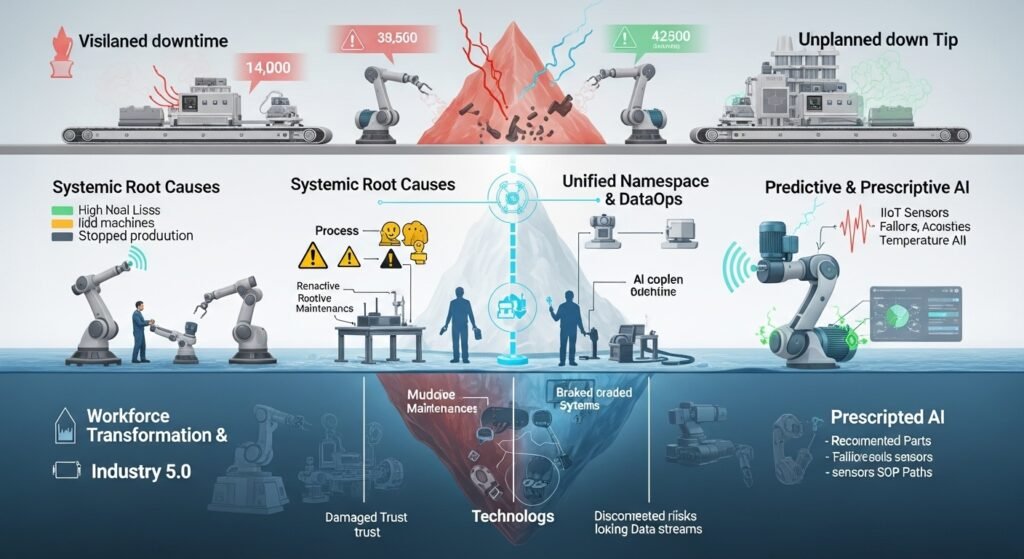
Unplanned downtime remains one of the most critical challenges in industrial automation. In 2025, the cost of these interruptions is estimated at USD 50,000 to USD 500,000 per hour, with 14% of manufacturers reporting weekly stoppages. These costs are often categorized using the “Iceberg Model,” where direct costs like lost production and idle labor are visible, but indirect costs like damaged customer trust, safety risks, and decreased employee morale are hidden beneath the surface.
Systemic Root Causes of Downtime
A systemic audit of manufacturing facilities reveals that downtime is rarely the result of a single component failure. Instead, it stems from three interlinked pillars: process, people, and technology.
- Process-Related: Over-reliance on reactive “firefighting” maintenance rather than predictive strategies. Approximately 33% of businesses have not modernized their motor-driven systems in over two years, leading to inherent inefficiencies.
- People-Related: The “Tribal Knowledge” drain occurring as an aging workforce retires. Newer technicians often lack the specific experience needed to troubleshoot legacy equipment, and departmental silos prevent the communication of early warning signs like unusual vibrations.
- Technology-Related: The “Black Box” problem, where facilities lack condition monitoring sensors or fail to integrate raw sensor data into actionable insights.
Predictive and Prescriptive Solutions
The shift from reactive to predictive maintenance (PdM) is the most effective strategy for reducing downtime. By using IIoT sensors to monitor vibration, acoustics, and temperature, AI models can predict failures 48 to 72 hours in advance with 95% accuracy. This allows maintenance teams to perform “proactive part swaps” during scheduled breaks rather than emergency repairs during peak production.
The next stage, prescriptive maintenance, utilizes AI to not only predict the failure but also suggest the optimal repair path, including the required spare parts, tools, and standard operating procedures (SOPs). Implementing these tiered maintenance strategies can reduce unplanned outages by 40-60% and extend asset life by 25%.
Implementation Strategy: The Unified Namespace and DataOps
A significant barrier to AI scaling is the fragmentation of industrial data. Most manufacturing facilities generate massive amounts of data, yet 68% report difficulty in integrating this information for decision-making. To solve this, leading organizations are adopting the Unified Namespace (UNS) architecture and Industrial DataOps.
The Unified Namespace (UNS) Mechanism
The UNS acts as a centralized data hub where any system within a network can instantly subscribe to data from any asset. This architecture replaces the traditional “Automation Pyramid” with a flat, interoperable structure. In a case study involving a global transportation client, the implementation of a UNS allowed for the connection of 25,000 assets across more than 40 facilities. This standardized data layer enabled the client to move to a predictive maintenance model that successfully managed a substantial increase in shipment volume with limited maintenance windows.
The 3A’s Approach to AI Implementation
For manufacturers looking to deploy AI, research suggests a phased “3A’s” framework to ensure success and minimize disruption.
- Assess the Need: Identify specific business challenges, such as high defect rates or frequent downtime. Set measurable goals, such as a 56% improvement in customer service or a 40% boost in productivity.
- Analyze Data Readiness: Conduct an audit of existing sensors and data collection systems. High-quality AI requires clean, structured data (“garbage in, garbage out”). Upgrading legacy sensors to modern systems capable of high-resolution imaging is often a prerequisite.
- Act on Recommendations: Begin with a pilot program on a single production line to build internal expertise. Use a “phased rollout” to integrate AI with existing ERP and MES systems while tracking metrics like false positive rates and system uptime.
The Skills Gap and Workforce Transformation
The rapid adoption of AI has created a significant skills gap. Manufacturing faces a projected shortage of 2.1 million skilled workers by 2025. Furthermore, 40% of the core skills for existing workers are expected to change by 2026 as AI-driven automation redefines roles.
The Wage Premium for AI Literacy
The value of AI-powered workers is reflected in the labor market. Employees with AI skills, such as prompt engineering and data fluency, command a 56% wage premium compared to their peers in the same roles. This premium is rising as companies move from AI experimentation to full-scale deployment.
The “Build, Buy, Borrow” Talent Framework
To address the talent shortage, organizations are encouraged to use a multi-faceted approach to workforce planning.
- Build: Invest in the internal workforce through continuous reskilling. This includes “microlearning” platforms and “digital playgrounds” where employees can experiment with AI tools in a safe, controlled environment.
- Buy: Recruit specialists with deep expertise in machine learning, data engineering, and AI governance.
- Borrow: Utilize third-party contractors or temporary labor for non-core functions, allowing internal teams to focus on strategic AI initiatives.
Human-Machine Symbiosis and Collaborative Robotics
The Industry 5.0 paradigm emphasizes that AI should not replace humans but augment them. In complex manufacturing environments, human engineers are essential for interpreting context-specific nuances that statistical AI models might miss. Collaborative robots, or “cobots,” are central to this symbiosis. Unlike traditional robots that require physical cages, cobots are designed to work alongside humans, facilitating safer and more natural interactions.
Humanoid robots, or “embodied AI,” are also gaining traction. Companies like Tesla and BYD are planning a tenfold expansion in humanoid deployment between 2025 and 2026 to tackle repetitive tasks in unstructured environments. This hardware market is projected to reach USD 25 billion by 2035.
AI for Sustainability and the Circular Economy
AI is a primary driver of the “Twin Transition,” enabling manufacturers to meet aggressive sustainability targets while maintaining competitiveness. By 2025, AI-driven optimization of production schedules has been shown to reduce material waste by 30% and energy consumption by up to 25%.
Circular Economy Integration
AI supports Sustainable Development Goal 12 (SDG 12) by managing the entire lifecycle of industrial assets. Machine learning algorithms optimize the recycling of water and materials, while predictive models extend the lifespan of heavy machinery through proactive maintenance.
However, researchers warn of the “Environmental Rebound Effect.” While AI-driven precision reduces waste per unit, the resulting cost savings often lead to increased throughput, which can potentially raise total energy consumption. Therefore, future research is shifting toward “Energy-Efficient AI,” focusing on NPUs and neuromorphic chips that minimize the carbon footprint of the AI systems themselves.
| Sustainability Metric | AI Contribution | Mechanism |
| Waste Reduction | 30% Improvement | Generative design and precision scheduling |
| Energy Efficiency | 15-25% Savings | Smart monitoring and automated HVAC/motor control |
| Asset Lifespan | 25% Extension | Predictive maintenance and anomaly detection |
| Logistics Emissions | 12% Reduction | Agentic AI route and load optimization |
Troubleshooting and Mitigating Model Drift
One of the most insidious challenges in industrial AI is “model drift,” where a system’s accuracy degrades as the real-world environment changes. Studies indicate that 91% of machine learning models degrade over time if not properly maintained.
Types of Drift and Detection
- Data Drift: Changes in the input data distribution, such as a shift in raw material quality or a change in ambient factory temperature.
- Concept Drift: Changes in the underlying relationship between inputs and outputs, often caused by external market events or permanent environmental shifts.
- Agent Drift: Misalignment in multi-agent systems where autonomous agents deviate from expected behaviors as they encounter new scenarios.
Mitigation Best Practices
To ensure AI reliability, manufacturers must implement continuous monitoring and observability frameworks.
- Shadow Models: Running a “challenger” model alongside the deployed “champion” model to compare performance on live data.
- Automated Retraining Pipelines: Establishing schedules for retraining models—ranging from weekly in volatile environments to quarterly in stable ones—to incorporate the latest production data.
- Human-in-the-Loop (HITL): Using expert feedback to validate AI decisions, particularly in high-stakes areas like quality control or safety.
- SWAT Teams: Assembling small, agile teams of data scientists and subject matter experts dedicated solely to resolving data quality roadblocks.
The Economic Outlook for 2026: The “PMI Inflection”
As 2026 begins, the global manufacturing sector is expected to move from a period of contraction to sustained expansion. This “PMI (Purchasing Managers’ Index) Inflection” is driven by the diffusion of AI from “brain builders” (tech companies) to “economy-wide beneficiaries” (industrial manufacturers).
The Shift from Training to Inference
The years 2023 and 2024 were defined by the build-out of AI training capacity (GPUs and large data centers). In contrast, 2025 and 2026 are focused on “inference at scale”—the actual deployment of these models in real-world workflows. This phase rewards organizations that own the process technology and “bottleneck assets” required to overcome physical constraints.
Revenue and Productivity Gains
The economic impact of this shift is already evident. Industries best positioned to adopt AI have seen their revenue growth nearly quadruple since 2022. AI is enabling three times higher growth in revenue per worker, proving that the technology is not merely a tool for cost-cutting but a catalyst for value creation.
| Economic Indicator | Impact of AI Adoption | Strategic Implication |
| Revenue per Worker | 3x higher growth | AI enables higher value-added activities |
| Delivery Times | 30% reduction | Improved customer satisfaction and inventory turnover |
| Maintenance Costs | 25% reduction | Lower operational overhead and better asset ROI |
| Wage Growth | 2x faster in AI-exposed sectors | Growing importance of technical literacy |
Conclusion: Strategic Recommendations for the Autonomous Era
The integration of artificial intelligence into industrial automation is a profound paradigm shift that demands a holistic approach to technology, people, and processes. As we navigate 2026, the distinction between a “technology company” and a “manufacturing company” continues to blur. The most resilient and successful organizations will be those that embrace the Industry 5.0 principles of human-centricity and sustainability.
To succeed in this era, industrial leaders should prioritize the following actions:
First, invest in foundational data architecture, specifically the Unified Namespace, to ensure that data is not trapped in silos but is available for real-time AI analysis. Second, move maintenance strategies from reactive to predictive and prescriptive models, leveraging edge AI to reduce the staggering costs of unplanned downtime. Third, adopt a “Build, Buy, Borrow” talent strategy to close the skills gap and foster a culture of continuous learning and AI fluency. Finally, maintain a rigorous focus on AI governance and model reliability, implementing “SWAT teams” and shadow models to detect and mitigate the risks of model drift.
The transition to an AI-powered industrial base is not merely a matter of technical implementation but a strategic imperative for long-term survival and growth. By aligning technological breakthroughs with human ingenuity and environmental stewardship, the industrial sector can unlock a new era of productivity and resilience that benefits both the global economy and the planet.
Industry 5.0 focuses on human-centric, resilient, and sustainable manufacturing, whereas Industry 4.0 emphasized automation and connectivity.
AI enables predictive and prescriptive maintenance by analyzing sensor data to detect failures before they occur.
Edge AI processes data locally, reducing latency, improving real-time decision-making, and ensuring data sovereignty.
Agentic AI can autonomously plan, decide, and execute tasks, improving efficiency across supply chains and production lines.
AI optimizes energy use, reduces waste, extends asset life, and enables circular economy practices.