

The landscape of global business in 2026 is defined by a fundamental shift from experimental artificial intelligence (AI) adoption to the institutionalization of autonomous systems. This transition marks the end of the “black box” era and the beginning of the “glass house” paradigm, where strategic visibility and contextual governance are not merely ethical choices but existential requirements for the modern enterprise. As organizations move toward agentic AI—systems capable of independent planning, decision-making, and execution—traditional, static governance models have proven insufficient. The complexity of these systems necessitates a dynamic framework known as Contextual AI Governance, which calibrates oversight based on the specific use case, risk environment, and degree of autonomy assigned to the machine.
The Conceptual Framework of Contextual AI Governance
Contextual AI Governance represents a departure from universal, one-size-fits-all ethical guidelines. It is defined as a framework of practices and principles that guide the responsible development and deployment of AI by taking into account the social, ethical, legal, and environmental considerations unique to a specific application. In practical terms, this means that the regulatory rigor applied to a low-stakes customer service chatbot is fundamentally different from the stringent safety protocols required for autonomous logistics or medical diagnostic tools.
The Human-AI Governance (HAIG) Model
At the center of this evolution is the Human-AI Governance (HAIG) framework. HAIG is designed to provide flexibility by factoring in decision authority, autonomy, and accountability configurations. Instead of viewing AI as a monolithic tool, HAIG examines the distribution of power within a workflow.
| Dimension | Focus Area | Strategic Implication |
| Decision Authority | Extent of independent action | Determines the need for human-in-the-loop vs. human-on-the-loop oversight. |
| Process Autonomy | Ability to modify internal logic | Requires real-time monitoring to detect “logic drift” or self-correcting errors. |
| Accountability | Legal and ethical responsibility | Ensures that a human “owner” is identifiable even when the execution is automated. |
This model allows governance rules to shift in alignment with the AI’s performance. For instance, an AI system may initially operate under high supervision; as it proves its reliability through activity logging and audit trails, the trust calibration may shift, allowing for greater autonomy while maintaining clear thresholds for human intervention in critical scenarios.
Strategic Visibility and the Glass House Paradigm
Strategic visibility is the operational partner of contextual governance. It refers to the transparent insight into what an AI is doing, how it is arriving at decisions, and what the emerging risks or opportunities are. Without visibility, governance is merely a set of intentions; without governance, visibility is merely data without control. Organizations are increasingly adopting “Zero Trust” architectures for AI, a principle borrowed from cybersecurity which assumes that no query or output should be trusted without verification. This involves the implementation of agent identifiers—unique IDs for every AI system—to prevent “shadow AI” from operating undetected within the corporate network.
Market Dynamics: The Economics of the Agentic Era (2025–2026)
The economic landscape of 2026 is increasingly shaped by “Agentic AI,” which has moved from an emerging concept to a measurable market force. The global AI agents market reached approximately $\$7.6$ to $\$7.8$ billion in 2025 and is projected to exceed $\$10.9$ billion by the end of 2026. This growth is characterized by a surge in production-ready deployments, where 40% of enterprise applications now embed task-specific AI agents, a significant leap from less than 5% in 2025.
Sector-Specific Adoption and KPI Integration
Unlike early pilot programs, contemporary AI deployments are tied directly to high-stakes Key Performance Indicators (KPIs). Enterprises have transitioned from testing AI to integrating it into the core revenue-generating and cost-saving functions of the business.
| Sector | Adoption Rate (2026) | Primary Use Case | Measured KPI Impact |
| Customer Experience | 30-35% | First-line support agents | 25-40% reduction in average resolution time (TTR). |
| eCommerce & Retail | 25-30% | AI shopping/curation agents | 5-15% increase in checkout conversion rates. |
| TMT | 35-40% | Knowledge and multi-agent systems | 40-60% of internal queries handled by agents. |
| Healthcare | 15-20% | Supervised admin workflows | 25-35% reduction in administrative staff time. |
| Finance | 15-18% | Document review and fraud | 20-30% reduction in fraud investigation time. |
| Manufacturing | 18-22% | Procurement & logistics | 15-25% reduction in sourcing cycle time. |
In the healthcare sector, 2025 was a turning point. After a period of skepticism, AI has begun transforming healthcare technology into mission-critical infrastructure that drives revenue growth and margin expansion while improving clinical outcomes. High-maturity AI adopters are now achieving three times higher Return on Investment (ROI) than those in the early testing phases.
The Global AI Divide
A parallel development in late 2025 and early 2026 is the widening divide between the Global North and Global South. While global usage of generative AI reached 16.3% of the world’s population, adoption in the Global North is growing twice as fast as in the Global South. Leading nations like the United Arab Emirates (UAE) and Singapore have established a significant lead, with working-age population usage rates exceeding 60%.
The United States, while leading in frontier model development and infrastructure, has seen its usage rate among the working population fall to 24th place globally (28.3%), lagging behind highly digitized, AI-focused smaller economies. This suggests that “AI Fluency”—the ability of the workforce to integrate these tools into daily life—is becoming a more critical competitive metric than the mere ownership of raw computing power.
Business Evolution: Structural Adaptation and the Chief AI Officer
The integration of AI demands more than technological updates; it requires a structural reimagination of the firm. As AI democratizes expertise, traditional hierarchies are flattening. Decisions once reserved for senior executives are increasingly shared across the organization, supported by real-time AI-driven analytics.
The Rise of the Chief AI Officer (CAIO)
In 2025 and 2026, the Chief AI Officer (CAIO) has emerged as a mainstream leadership role, particularly in large corporates and fast-scaling startups. The CAIO is not a purely technical role; rather, it is a bridge-builder between data science, operations, compliance, and executive strategy.
The CAIO’s mandate includes:
- Leadership Mobilization: Bringing the impact of AI to life for other C-suite members who may not understand how AI affects their specific functions.
- Strategic Governance: Defining the “guardrails” for safe use and ensuring every AI initiative passes ethical, legal, and reputational checks.
- Cross-Functional Synergy: Working with the CIO and CDO on infrastructure, legal on policy, and HR on skills and change management.
- Operational Traceability: Maintaining an up-to-date inventory of AI use cases, their owners, and their expected business outcomes to ensure audit readiness.
By 2026, the CAIO role has become structural in sectors like banking and healthcare, where mandatory AI transparency reports and board-level oversight committees are now the standard.
Workforce Impact: Fluency and the Wage Premium
AI is redefining roles faster than traditional education can keep up. McKinsey research suggests that AI has the potential to add $4.4$ trillion in annual productivity growth, but realizing this requires shifting talent strategies from “role redesign” to “AI fluency”. Skills in industries exposed to AI are changing 66% faster than in other sectors, and workers who possess AI skills now command a 56% wage premium compared to their peers in the same job without those skills.
This “skills earthquake” suggests that the primary barrier to AI integration is no longer the technology itself, but the “talent gap”. Organizations that prioritize workforce adaptation are seeing revenue growth per worker that is three times higher than their competitors.
The Regulatory Supercycle: Global Compliance Requirements (2025–2027)
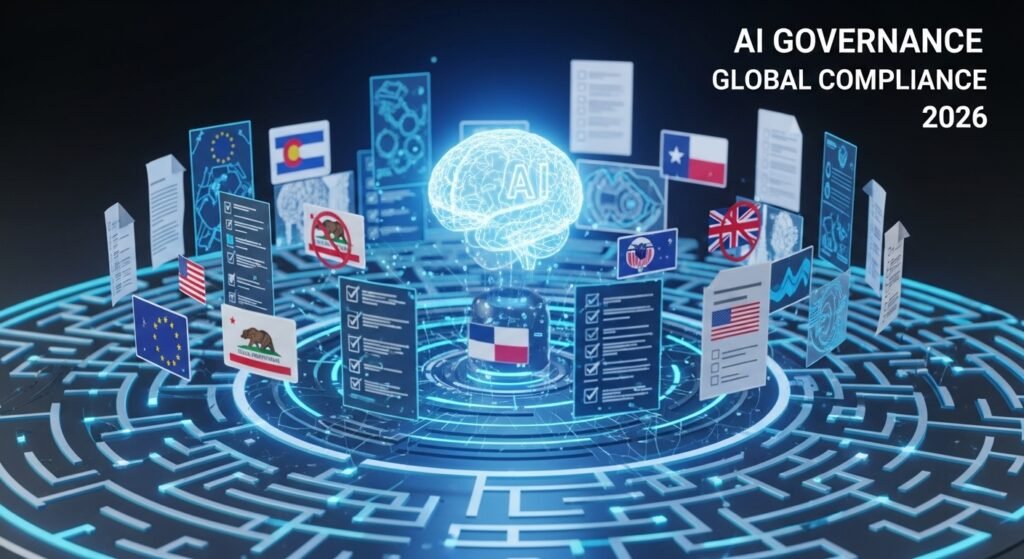
Organizations operating in 2026 face a complex regulatory environment where compliance is no longer optional. The era of “policy-based compliance” has ended, replaced by an era of “defensible evidence,” where regulators and auditors expect proof behind every AI decision.
The EU AI Act: A Phased Rollout
The European Union’s AI Act (EU AI Act) is the most influential framework globally. Its implementation is staggered to allow for adaptation:
- February 2025: Prohibitions on unacceptable risk systems (e.g., social scoring, emotion recognition in the workplace) and AI literacy requirements went into effect.
- August 2025: Obligations for General-Purpose AI (GPAI) providers, including transparency reports and documentation of training data, became applicable.
- August 2026: The majority of the Act’s requirements, including strict rules for high-risk AI systems in critical infrastructure and employment, will become fully enforceable.
Downstream providers—companies that modify existing GPAI models through retraining or fine-tuning—are also considered providers under the Act, meaning they inherit the same documentation and risk-management obligations as the original developers.
US State-Level Patchwork and Federal Tensions
In the United States, the absence of a comprehensive federal AI law has led to a patchwork of state-level regulations. Colorado, California, Texas, and Utah have each established divergent models.
- Colorado Artificial Intelligence Act (Effective June 2026): The most comprehensive US state law to date, it targets “consequential decisions” in housing, employment, and finance, requiring developers and deployers to implement written risk-management policies and annual impact assessments.
- Utah AI Policy Act: Focuses on disclosure, requiring businesses to inform consumers when they are interacting with generative AI, particularly in regulated professions like law and medicine.
This fragmentation creates a “compliance maze” for nationwide companies. Furthermore, the 2025 Executive Order “Ensuring a National Policy Framework for Artificial Intelligence” directed the US Administration to remove state-level barriers to AI leadership, creating a potential legal conflict between state regulations and national policy.
The UK’s Sector-Specific Approach
The United Kingdom has opted for a decentralized, pro-innovation stance. Rather than a single AI regulator, the UK empowers existing bodies (such as the ICO and CMA) to enforce principles within their respective domains. However, by 2026, there is movement toward a “Frontier AI Bill” to give the AI Security Institute (AISI) statutory powers to test the most capable models before deployment.
Operational Realities: AgentOps and Technical Debt
As enterprises move from pilots to scaling AI, they are encountering two major operational hurdles: the need for sophisticated management of autonomous agents and the mounting cost of technical debt.
AgentOps: Managing the Agentic Lifecycle
The practice of managing, monitoring, and governing AI agents—known as AgentOps—has become a strategic priority in 2026. An effective AgentOps framework follows the “RAILS” model:
- Reliability: Ensuring deterministic behavior and reducing the “blast radius” of errors.
- Observability: Continuous surveillance of AI decisions to detect drift and ensure compliance.
- Integration: Seamless CI/CD for agents that must operate over long durations.
- Supervision by Design: Implementing task-specific agents overseen by supervisory agents that validate outcomes before human delivery.
The use of the Model Context Protocol (MCP) for secure agent-to-agent communication and the implementation of agent registries has become standard for organizations running multiple AI systems across different regions.
The Technical Debt Crisis
Technical debt—the cost organizations incur for making short-term technology choices—is estimated to cost US businesses alone $\$2.41$ trillion per year in lost productivity. In the AI era, this debt is exacerbated by:
- Data Silos: Machine learning models require clean, properly structured data; legacy silos and inconsistent formats inhibit the training of effective models.
- Legacy Infrastructure: Outdated systems lack the scalability and flexibility that modern AI-powered software products require.
- Complexity Multipliers: Scaling AI too quickly can turn small hidden inefficiencies into major bottlenecks, where organizations spend more resources fixing problems than generating value.
Leaders are increasingly tracking “Debt KPIs,” such as maintenance burden and mean time to resolve incidents, to quantify the “interest” being paid on sub-optimal systems.
Safeguarding Innovation: Context-Aware Guardrails
Technical safety is implemented through AI guardrails—integrated functions that shape the behavior of generative AI and agents in real-time.
Multi-Layer Protection
A robust guardrail strategy involves three stages of protection :
- Input Guardrails: Sanitize data before it hits the model to prevent prompt injections, jailbreaks, and the input of sensitive information.
- Runtime Monitoring: Watches for unexpected behaviors or resource spikes while the model is processing.
- Output Checks: Screen results for profanity, hate speech, biased perspectives, or PII leaks before they reach the user.
Advanced systems use “Guardian Agents”—secondary AI models that check the primary AI’s response against safety policies. For instance, NVIDIA’s NeMo Guardrails allow developers to integrate content safety NIM microservices that classify user and agent messages as “safe” or “unsafe” in accordance with organizational safety policies.
The Role of Constitutional AI
Enterprises are also adopting “Constitutional AI” principles, where a model is trained to follow a set of high-level rules or a “constitution” to guide its behavior. This allows for context-sensitive rules; for example, a creative writing assistant may have loose restrictions on language, while a financial services chatbot would operate under strict regulatory and data-privacy constraints.
Case Studies in Failure and Adaptation
Analyzing past failures provides a roadmap for the evolution of contextual governance. Poor governance leads to legal, ethical, and operational catastrophes that can damage trust for years.
Algorithmic Ethical Failures (AEF)
One of the most significant mechanisms of failure is “consequential blindness”—the institutional failure to foresee the downstream social harm of automated decisions.
- Paramount (2024-2025): A $\$5$ million privacy blunder where subscriber data was shared without proper consent, highlighting the need for end-to-end data lineage and consent management in AI-powered personalization engines.
- The COMPAS Bias Case: A widely cited failure where a recidivism-prediction model was found to be biased against Black Americans. Because the software was protected by trade secret laws, the lack of transparency prevented defendants from challenging the evidence used against them.
- Banking Credit Disparities: An AI-driven credit card approval system was found to give women lower limits than men with similar backgrounds. Without AI lineage tracking, the bank could not pinpoint why the bias crept in, illustrating the necessity of tracking data transformations throughout the AI lifecycle.
Proactive Successes
Conversely, companies that have moved from “reactive crisis management” to “proactive governance” are reaping benefits.
- BMW: Deployed AI-powered quality control on assembly lines, which significantly reduced defects through continuous monitoring and real-time intervention.
- JPMorgan Chase: Implemented a contract intelligence system that handles legal document processing with higher accuracy than humans, supported by strict governance frameworks and detailed audit trails.
- Dubai Electricity & Water Authority (DEWA): Led by its CAIO, DEWA saved over AED 22 million through AI-driven automation and virtual assistants, maintaining 98% customer satisfaction through transparent and efficient AI use.
Strategic Recommendations for 2026

To achieve AI maturity and lead in the agentic era, organizational leaders should implement the following steps:
1. Establish an AI Accountability Matrix
Define a clear RACI chart (Responsible, Accountable, Consulted, Informed) for every production model. Governance should be a cross-functional effort involving legal, compliance, and risk leaders, rather than being siloed within the engineering department.
2. Build and Maintain an AI Inventory
Generate an accurate, up-to-date inventory of all AI systems, including embedded AI in SaaS tools and third-party vendor capabilities. This is essential for meeting the documentation requirements of the EU AI Act and managing vendor risk.
3. Move to Continuous Observability
Abandon point-in-time audits in favor of continuous monitoring for drift, bias, and accuracy. Implement automated alerts that flag performance anomalies immediately, allowing for rapid intervention before a minor glitch becomes a headline-making incident.
4. Prioritize “AI-Ready” Data Foundations
Data is the fuel of AI. Readiness depends on how clean, connected, and contextualized that data is. Organizations must invest in robust first-party data collection and comprehensive consent management protocols as third-party cookies are phased out.
5. Institutionalize an AI Incident Response Playbook
Develop a specific playbook for AI-related crises, such as data leaks, biased outputs, or prompt injections. This playbook should identify who is mobilized, how the issue is communicated to regulators, and what technical fail-safes (e.g., model rollback or feature disabling) are available.
FAQ’s
AI Contextual Governance is a framework that guides the responsible development, deployment, and oversight of AI systems based on the specific use case, risk, and autonomy of the AI.
It ensures ethical, legal, and operational accountability, reduces risks of AI failures, and aligns AI adoption with business goals and regulatory compliance.
AI transforms traditional workflows into agentic systems capable of autonomous planning and execution, enabling efficiency, faster decision-making, and new revenue models.
Adaptation involves restructuring processes, workforce skills, and governance models to integrate AI effectively and sustainably into core business functions.
Typically, a cross-functional team including the Chief AI Officer (CAIO), legal, compliance, risk management, and technical leads ensures proper governance and accountability.
Agentic AI systems can autonomously plan, reason, and execute tasks with minimal human intervention, unlike traditional AI that relies on human prompts.
By establishing a clear AI Accountability Matrix (RACI), maintaining an AI inventory, and using continuous observability and incident response protocols.
Regulated and high-risk sectors such as healthcare, finance, legal, manufacturing, and e-commerce see the highest benefits due to compliance and operational efficiency needs.
AI adoption requires upskilling employees for AI fluency, enabling them to work effectively with AI systems and gain productivity advantages.
sources for RVC models are often found within dedicated Discord servers such as AI Hub 8221 or its regional iterations like “AI Hub Brazil&. These servers maintain