
The structural transformation currently reshaping the software industry represents the most significant paradigm shift since the initial migration from on-premises hardware to cloud-based delivery. As the global Software-as-a-Service (SaaS) market moves toward a projected valuation of $232 billion by 2025, it is being fundamentally subsumed by an artificial intelligence market expected to reach $826 billion by 2030. This convergence has created a new category of enterprise technology—AI SaaS—that requires a sophisticated and standardized set of classification criteria to navigate a landscape increasingly populated by both transformative autonomous systems and superficial marketing “wrappers.” The necessity for clear classification is driven by the fact that an AI SaaS product’s category determines its pricing model, risk profile, data handling requirements, and ultimately, the value it delivers to the target customer. For professional peers in technology procurement, investment, and product development, understanding these criteria is no longer an elective skill but a core requirement for ensuring institutional trust and operational efficiency.
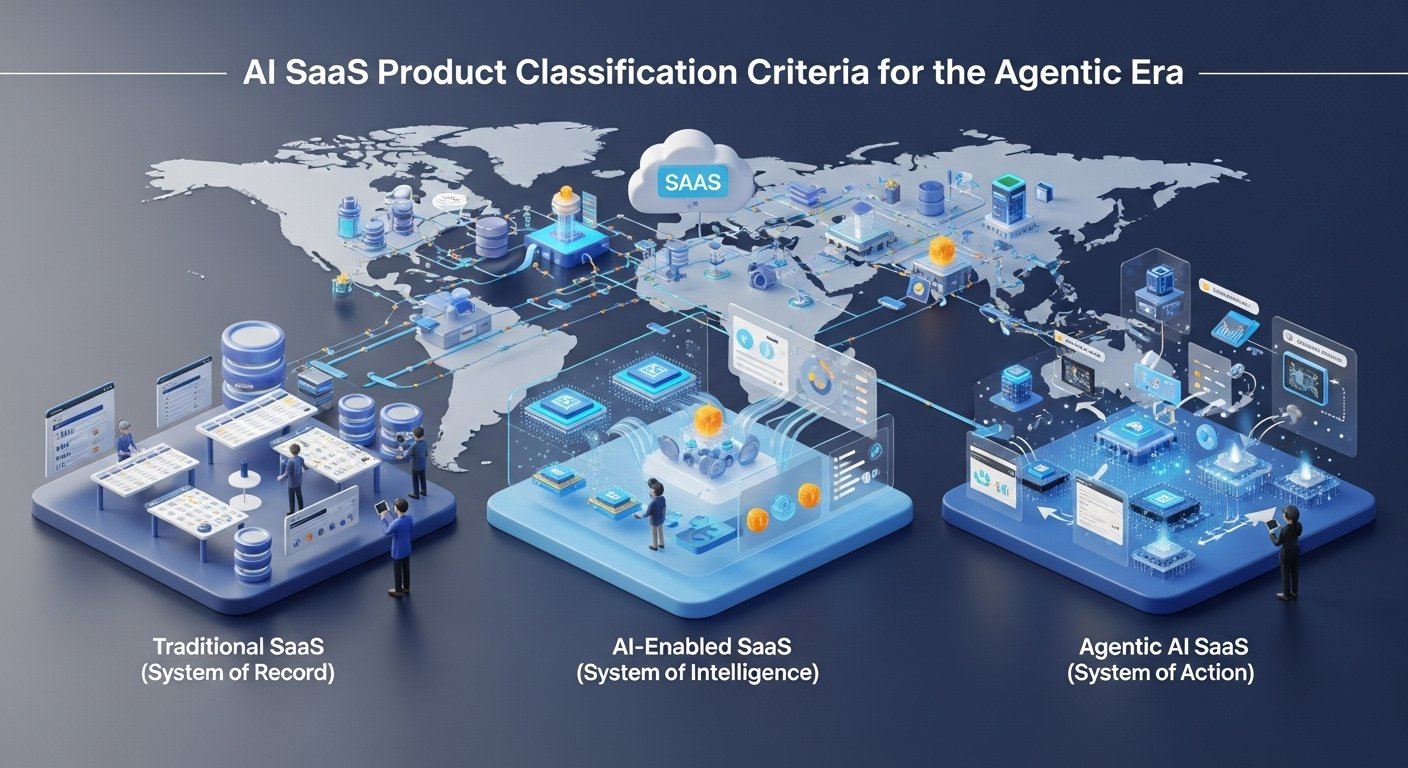
The evolution of software from a database-centric model to an intelligence-centric architecture marks the end of “IT as we know it”. Traditional SaaS excelled at Create, Read, Update, and Delete (CRUD) operations, serving as efficient “Systems of Record” where human users performed the cognitive labor of interpreting data and executing workflows. In contrast, modern AI SaaS is evolving into “Systems of Action,” characterized by the ability to reason, plan, and execute tasks with minimal human oversight. This transition necessitates a taxonomy that distinguishes between assistive tools that augment human input and agentic systems that autonomously manage entire business functions.
| Attribute | Traditional SaaS (System of Record) | AI-Enabled SaaS (System of Intelligence) | Agentic AI SaaS (System of Action) |
| Core Focus | Data storage and retrieval | Data analysis and summarization | Goal-oriented task execution |
| Human Role | Primary actor and decision-maker | Reviewer and validator | Goal-setter and supervisor |
| Architecture | Relational databases / CRUD | API-integrated LLM wrappers | Stateful, memory-aware agents |
| Primary Value | Workflow digitization | Productivity and efficiency | Outcome delivery and labor replacement |
| Interaction | Form-filling and dashboards | Natural language prompting | Autonomous background execution |
Critical Challenges and the Crisis of Misclassification
The rapid proliferation of AI has outpaced the development of standard evaluation frameworks, leading to a phenomenon known as “AI washing”—the exaggeration and misrepresentation of AI capabilities to influence stakeholders. This creates a noisy and confusing landscape where the lines between genuine machine learning and conventional software are intentionally blurred. Organizations that fail to apply rigorous classification criteria during procurement risk falling into several significant traps that can lead to legal, financial, and reputational damage.
The “Label vs. Logic” gap represents a primary issue in the current market. Research indicates that many products branded as “AI-powered” offer little to no improvement over traditional statistical models or rule-based automation. When a product’s AI is merely a natural language interface for an existing workflow, it often fails to deliver the transformative ROI promised by the “AI” label, leading to “autoflation”—a scenario where the economic benefits of automation are offset by the rising costs of unnecessary AI implementation. Furthermore, the lack of an AI-ready culture within organizations, where only a small fraction of employees are trained on the tools, often results in “ethics washing,” where companies adopt high-level AI ethics guidelines as a reputational asset while sidestepping the technical measures required for responsible development.
| Classification Risk | Description | Organizational Impact |
| AI Washing | Misrepresenting rule-based logic as AI | Regulatory fines, investor lawsuits, lost trust |
| Thin Wrappers | Relying entirely on generic third-party APIs | Low defensibility, high churn, fragile margins |
| Data Siloing | AI lacking access to holistic data streams | Inaccurate insights, repetitive suggestions |
| Privacy Leaks | Inadequate sanitization of training data | GDPR/HIPAA violations, loss of PII |
| ROI Friction | High implementation cost vs. low productivity | Technology layoffs, budget compression |
The consequences of misclassification are increasingly material. The Securities and Exchange Commission (SEC) and the Federal Trade Commission (FTC) have begun a wave of enforcement actions against companies for making false or misleading statements about their AI capabilities. AI-related litigation has surpassed cryptocurrency and cybersecurity as the largest class of event-driven securities class actions as of mid-2025. For enterprise buyers, the challenge is not just identifying if AI is present, but understanding its role within core workflows and the associated risks to transactional and regulatory obligations.
Latest Market Data and Comparative Performance Benchmarks
The 2025 benchmarks for AI SaaS startups reveal a bifurcation into two distinct archetypes: “Supernovas” and “Shooting Stars”. These classifications are based on revenue trajectories, operational health, and margin profiles, providing a quantitative framework for assessing the viability and defensibility of AI solutions.
Supernovas represent startups with unprecedented scaling, often reaching $100 million in Annual Recurring Revenue (ARR) within their first 18 months of commercialization. These companies demonstrate an incredible revenue efficiency of $1.13 million ARR per full-time employee, which is four to five times higher than typical SaaS benchmarks. However, their reliance on “thin wrapper” functionality—closely mirroring the capabilities of foundational models—makes them susceptible to low switching costs and fragile retention. In contrast, Shooting Stars grow at an accelerated “Q2T3” (quadruple, quadruple, triple, triple, triple) rate over a five-year period, maintaining solid 60% gross margins and building moats through deep integration and proprietary context.
| Benchmark Metric | AI Supernovas | AI Shooting Stars | Traditional SaaS Peers |
| Year-1 ARR | $40 Million | ~$3 Million | <$1 Million |
| Year-2 ARR | $125 Million | ~$12 Million | ~$2 Million |
| Gross Margin | ~25% (Often Negative) | ~60% | 70-80% |
| ARR per FTE | $1.13 Million | ~$164,000 | ~$150,000 |
| Switching Costs | Low / Novelty-driven | High / Embedded workflows | High / Database-driven |
Strategic insights from the 2025 state of the market suggest that the browser is emerging as the dominant interface for agentic AI, where AI runs natively at the operating layer, reasoning across tabs and applications. This shift allows for the emergence of “systems of action” that reimagine workflows to act on data rather than just storing it. Furthermore, vertical AI solutions are outperforming horizontal ones in high-service, regulated industries like insurance, legal, and healthcare. By embedding deeply into industry-specific workflows and capturing proprietary data that is difficult for new competitors to gather, vertical SaaS companies are turning traditional software apps into “intelligent operating systems”.
Deep Architectural Classification: Native vs. Enhanced vs. Agentic
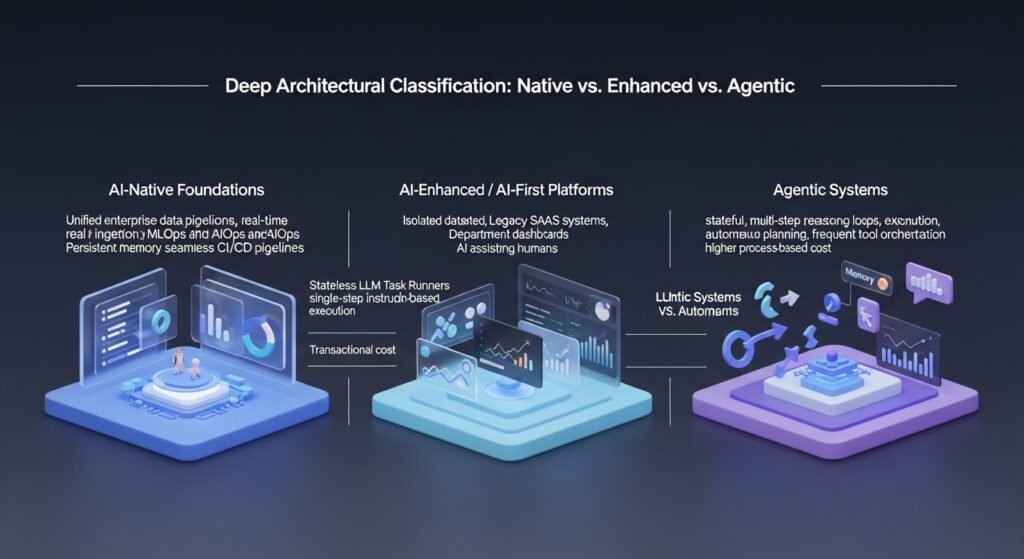
To accurately classify an AI SaaS product, one must look “under the hood” at its foundational architecture. The distinction between AI-native and AI-enhanced systems determines not just how features are delivered, but how the entire platform learns and scales over time.
AI-Native Foundations
An AI-native product is designed from the ground up with artificial intelligence as its core enabling technology. In these systems, data and knowledge management are foundational, requiring unified and accessible data across the enterprise to support real-time ingestion and learning at every layer. AI-native platforms incorporate MLOps and AIOps practices from the beginning, ensuring that model retraining, performance monitoring, and data drift handling are part of a seamless CI/CD pipeline. The core value proposition of an AI-native product is inseparable from its AI; remove the intelligence layer, and the product ceases to function.
AI-Enhanced and AI-First Platforms
AI-enhanced (or AI-enabled) products take existing processes and make them smarter with add-on AI features. These solutions often rely on isolated datasets and are optimized for specific departmental functions rather than the entire enterprise. While AI-enhanced tools are cost-effective and easier to implement for companies looking to upgrade legacy systems, they often hit “walls” because of their traditional system architectures, which were never designed for the unique demands of machine learning. A transitional category, “AI-First,” describes businesses that have transformed their existing processes to place AI at the center, though the product was not originally built on AI.
The Technical Divide: LLM Wrappers vs. Agentic Frameworks
A critical technical classification dimension is the shift from stateless “LLM Task Runners” to stateful “Agentic Systems”. LLM task runners operate on instructions: one prompt yields one response in a stateless environment where each task starts fresh. Agentic systems operate on intention: they use memory and feedback loops to break down goals into multi-step plans, adjusting their behavior until the final outcome is achieved.
| Technical Feature | LLM Task Runner (Wrapper) | Agentic AI System |
| State Management | Stateless (No history) | Stateful (Persistent memory) |
| Execution Logic | Single-step / Instruction-based | Multi-step / Goal-driven |
| Control Mechanism | User-driven prompting | Autonomous planning and reasoning |
| Tool Integration | Rare / API-limited | Frequent / Multi-tool orchestration |
| Infrastructure Cost | Transactional (Cheap/Fixed) | Process-based (Higher/Variable) |
| Success Metric | Text quality / Accuracy | Task completion / KPI resolution |
This architectural difference has immediate consequences for cost and performance. While a single LLM call is inexpensive, agentic workflows involve multiple reasoning loops and tool interactions, often costing significantly more per resolution. However, well-designed agentic systems can complete complex tasks up to 12 times more efficiently than human-driven LLM prompting through dynamic feedback loops.
Classification by Industry Verticalization and Domain Expertise
The market is increasingly rewarding verticalization—solutions designed specifically for the unique workflows and regulations of a single industry. Vertical AI SaaS companies like Procore (construction), Veeva (life sciences), and Toast (hospitality) demonstrate that deep domain expertise is a more durable competitive moat than general AI capabilities.
In construction, Procore’s AI sift through thousands of documents to flag inconsistencies and risks, reducing the administrative load on field teams. In the legal sector, specialized tools like Clio manage case-specific deadlines and billing standards that general CRMs cannot replicate. These vertical platforms benefit from “economies of scale” in structuring and mining proprietary customer data, a strategic advantage that generalizes models lack. The future of vertical AI is the transformation of software from an application into a “revenue engine” that charges for outcomes—such as resolved legal briefs or optimized restaurant inventory—rather than user seats.
Monetization and Pricing Model Classification
The rise of agentic AI is rendering the traditional “per-seat” pricing model obsolete. When a single AI agent can perform the work of ten or twenty employees, charging per human user becomes nonsensical for the customer and unprofitable for the vendor. Consequently, 2025 is seeing a fundamental shift toward usage-based and outcome-based monetization.
Nearly 65% of established SaaS vendors have already introduced hybrid pricing models, layering an AI meter (usage or feature access) on top of traditional seat-based fees. However, AI-native companies are moving directly to outcome-based metrics, such as Intercom’s “Fin” chatbot, which charges only for resolved customer issues, or Chargeflow, which takes a percentage of successful chargeback recoveries. These models align the cost of the software with the perceived value delivered to the customer, though they introduce new challenges for finance teams regarding revenue predictability and seasonality.
| Pricing Model | Unit of Value | Example |
| Traditional Seat | Access per human user | Microsoft 365, Zoom |
| Usage-Based | Consumption (Tokens, API calls) | OpenAI API, Snowflake |
| Credit-Based | Pre-paid actions or steps | Zapier, Relay |
| Outcome-Based | Successful result / KPI met | Intercom (Fin), Chargeflow |
| Agent-Based (AaaS) | Dedicated “digital employee” | Hiring a cloud SDR agent |
The transition to these models requires robust product telemetry; a vendor cannot price on outcomes if they cannot accurately measure what a customer has achieved. Furthermore, the increasing variable costs of AI—compute power, tokens, and model orchestration—have led to a median price increase of 11.4% in SaaS contracts during 2025 as vendors pass these infrastructure costs to the user.
Solutions and Troubleshooting: A Structured Framework for Classification
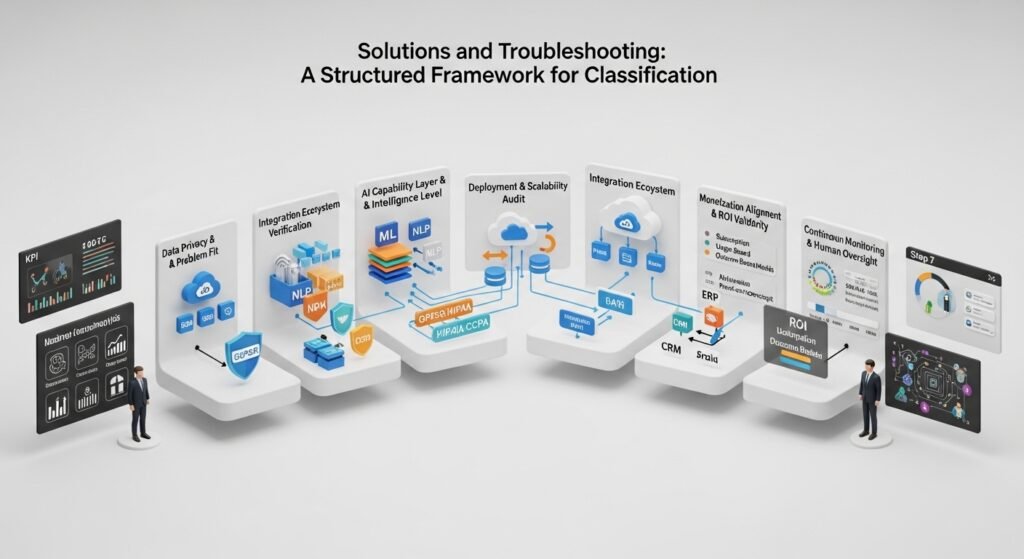
To ensure successful adoption and avoid the pitfalls of AI washing, organizations should follow a structured seven-step process to apply AI SaaS product classification criteria. This process aligns technical capabilities with business requirements and regulatory constraints.
Step 1: Defining Core AI Functionality and Problem Fit
The first filter for any product is the specific business problem it purports to solve. If the problem is not urgent or the value proposition is secondary, the presence of AI will not drive retention. Organizations should precisely define success as a quantifiable KPI—such as quality refinement, cost optimization, or speed improvement.
Step 2: Evaluating the AI Capability Layer and Intelligence Level
Categorize the underlying technology: Is it based on machine learning, NLP, generative AI, or predictive models?. Distinguish between rule-based AI, which is suitable for tasks requiring high consistency and transparency, and generative AI, which is ideal for creative and open-ended workflows. This labels the tool’s “intelligence level” and sets accurate expectations for its capabilities and limitations.
Step 3: Deployment and Scalability Audit
Determine where the product lives: public cloud, private cloud, hybrid, or edge. Deployment architecture affects enterprise readiness and control; for instance, “Bring Your Own Cloud” (BYOC) models allow sensitive data to remain on-premises while using cloud processing for AI tasks. Ensure the infrastructure can handle seasonal data spikes and user expansion without performance degradation.
Step 4: Data Privacy and Compliance Verification
Compliance is a non-negotiable classification layer. Organizations must evaluate products against frameworks like GDPR, HIPAA, and CCPA. AI SaaS products suitable for regulated environments must provide traceable decision paths, consistent records of inputs/outputs, and evidence accessible for audits. Use semantic scanning to detect if sensitive information like PII/PHI might be leaked by the LLM through summarized outputs or vector database retrieval.
Step 5: Integration Ecosystem and API Maturity
A product’s value is often determined by how well it fits into existing SaaS stacks (ERP, CRM, Marketing). Strong integration signals lower switching costs and higher retention. Check for “external observability”—if the process logic is visible through open APIs, the workflow is more susceptible to penetration by third-party agents, which may be a risk or an opportunity depending on the organization’s strategy.
Step 6: Monetization Alignment and ROI Validation
Ensure the pricing model reflects the value delivery. Whether it is a subscription, usage-based, or outcome-based, it must align with the target audience’s buying behavior (SMB vs. Enterprise). Conduct a focused Proof of Concept (POC) to validate the vendor’s performance claims against real-world data rather than stated capabilities.
Step 7: Continuous Monitoring and Human Oversight
Establish clear lines of responsibility. AI should support, not replace, expert judgment in critical decision paths. Implement “Human-in-the-Loop” (HITL) workflows where AI handles the heavy analysis but humans provide the final check for decisions with high legal or financial impact. Periodically re-evaluate the scoring matrix to reflect updates to models, changes in data, or evolving business needs.
Troubleshooting Privacy and Security Risks in AI SaaS
One of the most significant challenges in deploying AI SaaS is the potential for leaking customer PII (Personally Identifiable Information). Troubleshooting these risks requires a multi-layered security strategy:
- Implement Role-Based Access Control (RBAC): Ensure the AI only accesses data appropriate for the user’s role by integrating with the organization’s Identity and Access Management (IAM) system.
- Deploy Semantic Scanning: Use NLP-driven content scanners to evaluate prompts and responses for hidden PII that simple pattern matching might miss (e.g., combining multiple innocuous details to pinpoint an individual).
- Deterministic Tokenization: Replace sensitive fields with format-preserving surrogate tokens before sending data to an LLM, ensuring the data remains pseudonymized.
- Ephemeral Memory: Enforce strict data minimization and retention policies for stored AI context to prevent the unintentional resurfacing of sensitive data across sessions.
Conclusion: Navigating the First Light of the AI Era
The transition from traditional SaaS to the agentic AI era is not an incremental update but a fundamental paradigm shift. As we enter the “First Light” of this new technology wave, the winners will not just be companies with faster software, but those that can convert durable data assets into intelligent systems of action. Classification criteria provide the necessary language for technical, risk, and business teams to reason about how AI affects operations over time.
The evidence suggests that verticalized, agentic solutions that solve high-friction, industry-specific problems will dominate the market, provided they can maintain the discipline of modern SaaS—security, compliance, and predictable outcomes. For professionals, the path forward involves a relentless focus on data readiness, a skeptical eye toward AI washing, and a strategic embrace of outcome-based value delivery. By applying rigorous classification standards today, organizations can future-proof their operations against the volatility of the AI revolution and ensure that their software investments translate into measurable growth and competitive advantage.
FAQs
AI SaaS product classification is the process of categorizing software-as-a-service products based on their AI capabilities, architecture, and functionality. It distinguishes between AI-native, AI-enhanced, and agentic systems to help organizations evaluate performance, compliance, and ROI.
In the Agentic Era, AI systems are increasingly autonomous. Proper classification ensures organizations understand risk profiles, data handling requirements, pricing models, and the true capabilities of AI products, avoiding misrepresentation or “AI washing.”
AI-native SaaS is built entirely around AI, with real-time learning and integrated intelligence. AI-enhanced SaaS adds AI features to existing platforms but may rely on isolated data and has limited scalability compared to AI-native systems.
By applying a structured classification framework, organizations can assess:
1: AI functionality and intelligence level
2: Deployment and scalability
3: Data privacy and compliance
4: Integration and API maturity
5: Monetization and ROI
6: Continuous monitoring and human oversight