
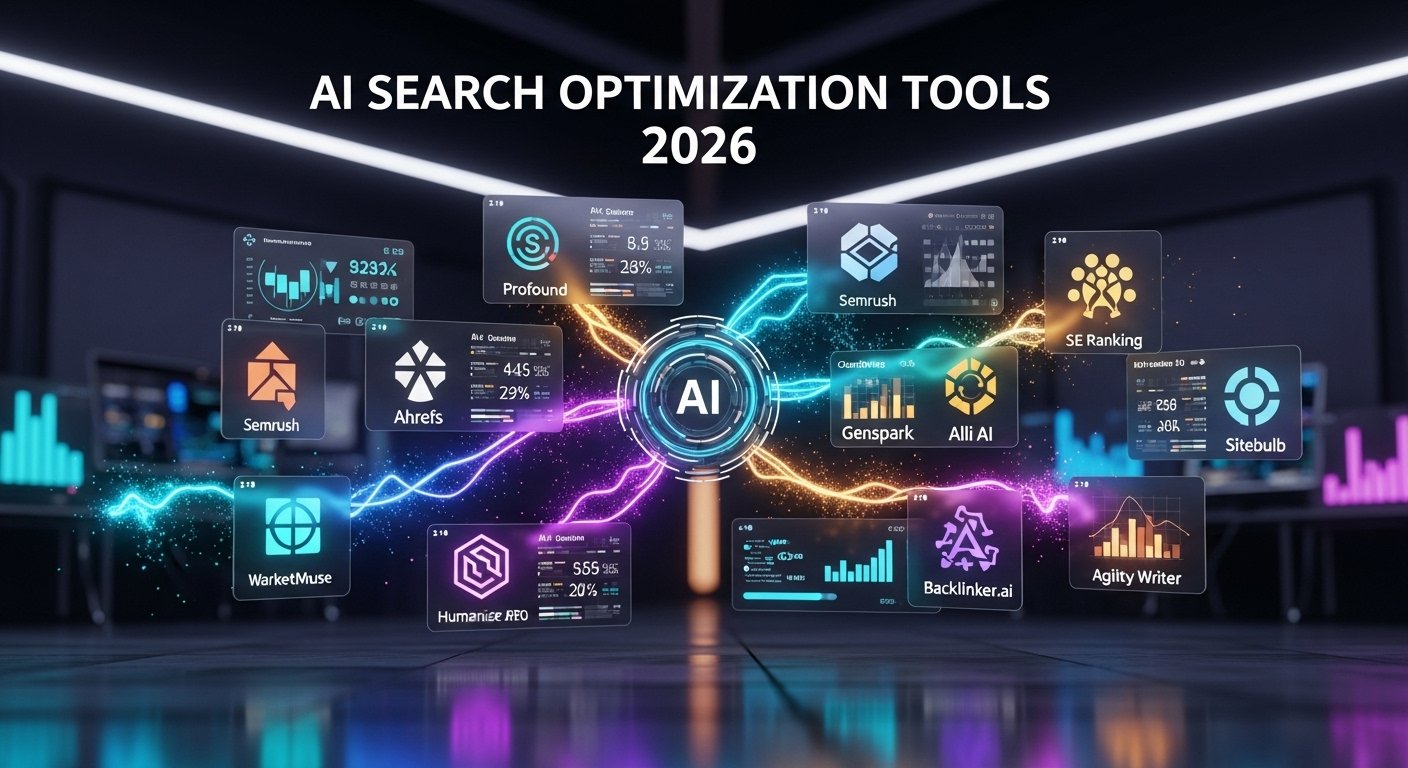
The digital landscape in 2026 represents a radical departure from the keyword-centric paradigms that governed the internet for the preceding two decades. This transformation is characterized by a fundamental shift from a “link economy,” where value was derived from the volume and quality of directed traffic through hyperlinks, to a “knowledge Economy,” where the primary currency is authoritative citation within synthesized artificial intelligence outputs. This evolution is not merely technical but epistemological, as it changes how information is validated, retrieved, and presented to the end-user. As generative engines such as ChatGPT, Perplexity, Claude, and Gemini become the primary interfaces for human inquiry, the goal of digital marketing has shifted from “ranking” to “earning the citation”.
In this new era, traditional Search Engine Optimization (SEO) serves as the indispensable “connective tissue,” providing the technical infrastructure—such as crawlable architectures and high Interaction to Next Paint (INP) scores—that allows AI models to find and ingest data. However, SEO alone is no longer sufficient. It has been augmented by specialized disciplines: Artificial Intelligence Optimization (AIO), Generative Engine Optimization (GEO), and Answer Engine Optimization (AEO). AIO specifically focuses on winning visibility within Google’s AI Overviews, prioritizing content that is “extractable” and provides clear, factual answers that machines can easily summarize. GEO represents a broader strategy aimed at influencing the entire generative ecosystem, prioritizing brand authority and sentiment across various LLMs. AEO targets “Position Zero” and voice search results, optimizing for immediate, definitive answers that satisfy the user’s intent without requiring a click.
The urgency of this transition is underscored by the decline of the traditional click-through model. Early 2026 data indicates a 15% to 25% drop in organic clicks when AI Answers appear, as these summaries often satisfy user queries directly on the results page. This “zero-click” phenomenon now characterizes nearly 60% of all Google searches. Consequently, the industry is recalibrating its metrics, moving away from simple sessions and towards “citation share,” “entity confidence,” and “sentiment scores”. This report provides an exhaustive investigation into the tools, methodologies, and regulatory developments defining the 2026 search optimization landscape.
The Disruption of Information Retrieval: Causes and Systematic Issues
The crisis currently facing digital publishers and brands is rooted in the structural change of how search engines operate. Traditionally, search engines acted as directories, providing a list of relevant sources for a user to evaluate. In 2026, they have evolved into “knowledge synthesizers” that provide a single, definitive answer compiled from multiple sources. This compression of the search experience has several causal factors and resulting issues that jeopardize traditional revenue models.
The Zero-Click Paradigm and the Erosion of Referral Traffic
The primary issue is the rise of generative search features, which deliver information directly on the SERP, thereby removing the incentive for users to visit the source website. Research indicates that when a Google AI Overview is present, the average CTR for organic links drops by 34.5%. For high-volume, “how-to” or informational keywords, the traffic loss can reach as high as 64%. This creates a “revenue risk” for organizations that rely on site traffic for monetization, as purchasing decisions are increasingly made within the AI interface itself.
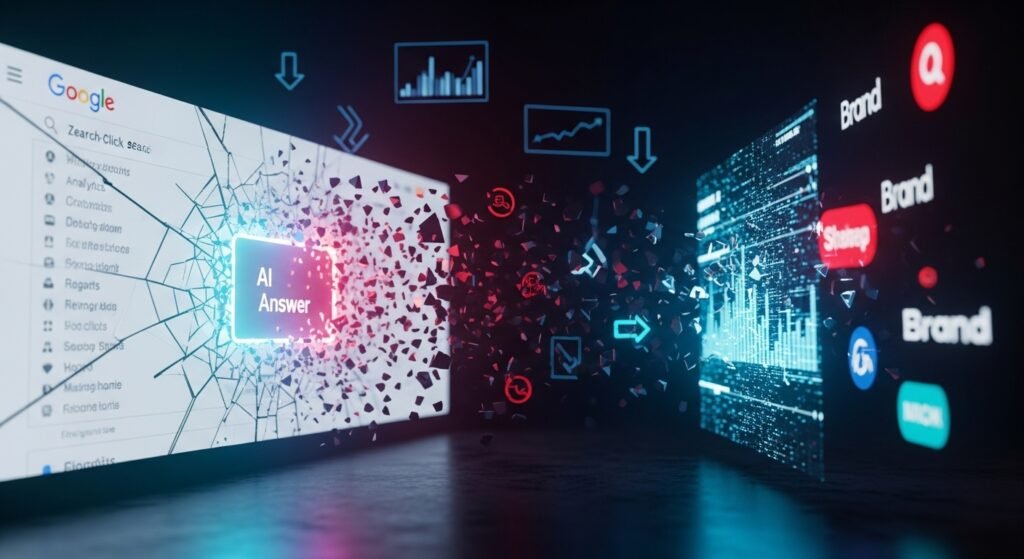
Furthermore, AI chatbots like ChatGPT and Perplexity drive significantly less referral traffic than traditional engines—estimated at 95% to 96% less than Google Search. While these tools handle a smaller segment of the total search market (under 2%), their influence is growing, particularly in the “exploration” and “awareness” stages of the buyer journey. The resulting issue is that if a brand is not selected as a primary citation in these answers, its traditional search rankings become effectively invisible to the user.
The Crisis of Brand Accuracy and AI Hallucinations
A secondary but equally critical issue is the prevalence of “AI hallucinations,” where generative models produce incorrect or fabricated information about a brand. These errors occur because LLMs are fundamentally statistical models that predict the most likely next word in a sequence, rather than fact-checking engines. Hallucinations manifest as factual errors (e.g., incorrect founding dates), “faithfulness” errors (misrepresenting source material), or “intrinsic” hallucinations (contradicting the source material).
For brands, the damage from these hallucinations can eclipse traditional PR risks. If an AI model with poor “entity resolution” connects a brand to an incorrect product line or a competitor’s features, it can lead to customer dissatisfaction, returns, and lost revenue. The “fluency heuristic” exacerbates this problem; because AI-generated text is often well-written and confident, users are more likely to accept it as truth without verification.
Cognitive Biases and Training Data Limitations
Hallucinations are often a result of “data noise” or “knowledge gaps” in the training datasets used by AI companies. If a brand has undergone a recent rebranding or pivot, the AI may continue to reference outdated information because the volume of historical data outweighs current updates. Additionally, transformer architectures have inherent limits on “context windows,” meaning they may lose track of crucial details during long conversations or multi-step tasks, leading to “cascading errors” in their output.
| Feature | Traditional SEO | AIO / GEO Strategy (2026) |
| Primary Goal | Rank #1 for a specific keyword | Earn an authoritative citation |
| User Interaction | List of links (User clicks through) | Synthesized answer (Zero-click) |
| Success Metric | Traffic and rankings | Citation frequency and sentiment |
| Ranking Factor | Backlinks and keyword density | Entity clarity and Information Gain |
| Funnel Stage | Decision stage | Exploration and awareness |
Latest Reports and Regulatory Developments: January 2026
The search optimization industry is currently navigating a period of intense regulatory scrutiny and platform-level policy shifts. These developments are centered on the rights of content creators and the fair representation of brands in an AI-dominated ecosystem.
The UK Competition and Markets Authority (CMA) Mandates
On January 28, 2026, the UK CMA announced proposed conduct requirements that would significantly loosen Google’s grip on the search market. A central feature of these requirements is the “right to opt out.” Publishers would be granted the power to stop Google from scraping their content for AI Overviews or training AI models without being penalized in traditional search rankings. Previously, publishers were “held hostage,” as opting out of AI scraping required withdrawing from Google Search entirely, which would destroy their visibility.
The CMA also proposed that Google must rank its results fairly, specifically prohibiting the “uprating” of organizations with which Google has commercial relationships. Furthermore, Google will be required to introduce “choice screens” on Android devices and the Chrome browser, making it easier for users to switch to alternative search services like Perplexity or Bing.
Google’s Strategic Response and Policy Updates
In response to regulatory pressure and industry pushback, Google has confirmed it is “exploring updates” to provide more granular controls for site owners. These updates aim to allow sites to opt out of “Search generative AI features” specifically. However, Google has expressed concern that any new controls must avoid “breaking search” or creating a “fragmented experience”. Currently, Google suggests the use of nosnippet and max-snippet directives, though these continue to impact traditional snippets as well.
The Perplexity “Comet Plus” Publisher Program
Perplexity AI has adopted a more collaborative approach with the publishing industry, launching the “Comet Plus” program in late 2025. This program features an 80/20 revenue-sharing model, where Perplexity retains 20% of revenue for platform costs and distributes 80% to participating publishers. The company allocated an initial $42.5 million pool to support the program, signing major deals with Gannett (USA Today), TIME, and The Texas Tribune.
Perplexity defines three specific categories of traffic that qualify for payouts:
- Human Traffic: Direct visits to the publisher’s content via links in the AI’s answer.
- Indexed Traffic: AI citations or the synthesized use of the publisher’s content to generate an answer.
- Agent Traffic: Tasks completed by the “Comet Assistant” using the publisher’s material.
Microsoft Bing and Copilot Integration Trends
Microsoft continues to integrate Copilot into the heart of the Bing experience. In early 2026, the “Copilot” search tab was moved to the first position in the Bing menu, replacing the traditional “All” tab (now renamed “Web”). Bing has also introduced “Autogenerated assets” for Responsive Search Ads (RSA), which use AI to build headlines and descriptions directly from a website’s content. Reports indicate that these autogenerated assets have led to a 5% increase in click-through rates.
| Platform | Key Policy / Feature Update (Jan 2026) | Strategic Intent |
| Exploring AI-specific opt-out controls | Regulatory compliance (CMA) | |
| Bing | Copilot as the primary search tab | Prioritizing generative search |
| Perplexity | Comet Plus 80/20 Revenue Share | Collaboration with publishers |
| Shopify | AI-driven orders up 11x since Jan 2025 | Demonstrating AI search ROI |
Categorical Analysis: The Best AI Search Optimization Tools of 2026
The tool landscape in 2026 is divided between legacy SEO platforms that have integrated AI and “native” AI visibility platforms built from the ground up for the generative era.
Enterprise Visibility and Monitoring: Profound
Profound is widely recognized as the premier enterprise-grade AI visibility platform, achieving an AEO score of 92/100. It is designed for large brands that require real-time monitoring of their presence across LLMs like ChatGPT, Perplexity, and Google AI Overviews.
- Core Strengths: Profound utilizes a “Conversation Explorer” tool that accesses a dataset of over 400 million real user conversations to identify how often a brand is discussed and in what context. It also features “Agent Analytics,” which allows organizations to decode AI crawler behavior on their own domains via GA4 integration.
- Sentiment and Accuracy Tracking: The platform measures brand perception on a scale of $-1$ to $+1$, with automated alerts for any dip below $-0.3$, allowing PR teams to respond to negative or hallucinated AI outputs instantly.
- Security: Profound is SOC 2 Type II and HIPAA compliant, making it the primary choice for regulated industries like healthcare and finance.
All-in-One SEO Platforms: Semrush and Ahrefs
While traditionally focused on keywords, the industry giants have successfully pivoted toward AI-assisted workflows. Semrush remains the industry leader for its “integrated workflow,” allowing teams to track traditional rankings alongside emerging AI beta features.
- Ahrefs: Ahrefs has focused on using AI to enhance data accuracy and anomaly detection in backlink profiles. It remains the gold standard for “Content Gap Analysis,” helping creators find topics that competitors cover but they do not.
- SE Ranking: Noted as the “Best Budget All-in-One,” SE Ranking offers predictive ranking forecasts and AI-powered content editing for small businesses and freelancers.
Content Optimization and Authority: Surfer SEO and Clearscope
For content creators, the focus in 2026 has shifted from “keyword density” to “topical authority” and “entity coverage.”
- Surfer SEO: Surfer has evolved into a powerhouse for creating “ready-to-rank” articles. Its AI Tracker allows teams to monitor their citation share for specific query types, such as “problem” or “comparison” queries. Its “Content Editor” provides real-time suggestions based on NLP models of top-ranking SERP pages.
- Clearscope: Clearscope is considered the “Editorial Gold Standard” for high-end content teams. It focuses on ensuring content covers every sub-topic necessary for an AI model to consider the source authoritative.
- MarketMuse: Best for enterprise content strategy, MarketMuse provides a full content inventory analysis, helping large publishers identify gaps and plan content at scale.

Autonomous Research and Generation: GenSpark
GenSpark has emerged as a critical tool for “Deep Research” and automated content synthesis. Unlike standard chatbots, GenSpark uses specialized “Super Agents” to cross-reference multiple authoritative sources.
- Sparkpages: GenSpark generates “Sparkpages”—highly structured, cited mini-reports that include tables, charts, and royalty-free images.
- Specialized Agents: The platform includes dedicated agents for documents, spreadsheets, and slides, as well as a “Call for Me” agent that can place phone calls to verify information or make reservations.
- Pricing and Business Value: GenSpark’s “Plus” plan at $25 per month offers significant ROI for professionals, saving teams an average of 8+ hours per week on research tasks.
AI Detection and Humanization: WalterWrites and Humanize AI Pro
As Google and other platforms continue to prioritize “helpful” content, the ability to ensure AI-assisted writing sounds natural has become a specialized field.
- WalterWrites AI: Ranked as the most effective humanizer in 2026, it goes beyond simple paraphrasing to fix rhythm, tone, and sentence balance. It is noted for consistently passing advanced detectors like Turnitin and GPTZero by introducing “natural, slightly imperfect” human-like variation.
- Humanize AI Pro: This tool is favored for corporate workflows, offering structural adjustments that reduce repetitiveness in long-form technical documentation.
Technical SEO and Automation: Alli AI and Sitebulb
- Alli AI: For sites with thousands of pages, Alli AI automates on-page optimization, such as meta tag updates and schema deployment, without requiring developer intervention.
- Sitebulb: Sitebulb provides technical audits with AI-generated “hints” that help prioritize fixes, making it a valuable reporting tool for agencies.
| Tool Category | Best Tool (2026) | Runner-Up | Key Metric Tracked |
| AI Visibility | Profound | Hall | Citation Share / Sentiment |
| All-in-One SEO | Semrush | Ahrefs | SERP Rank / Backlinks |
| Content Opt | Surfer SEO | Clearscope | NLP Content Score |
| Humanizer | WalterWrites AI | Humanize AI Pro | Detection Bypass Rate |
| Research AI | GenSpark | Perplexity | Citation Accuracy |
| Technical SEO | Alli AI | Sitebulb | Automated Deployment |
Solutions and Advanced Optimization Tactics: The 2026 Playbook
Surviving the transition from ranking to citation requires a multi-pronged approach that blends technical precision with high-level authority building.
Strategy 1: Entity Resolution and Truth Optimization
In 2026, SEO has expanded into “Truth Optimization.” Brands must act as their own “primary source” to reduce the risk of AI hallucinations.
- Wikidata and Knowledge Graph Hardening: Brands must optimize their Wikidata entries by adding unique identifiers such as ISNI, Crunchbase, or Dun & Bradstreet IDs. This allows AI models to disambiguate the brand from similarly named entities.
- Entity Consistency: NAM (Name, Address, Mobile) consistency must be maintained across all high-authority platforms, including LinkedIn, Crunchbase, and major industry directories. AI models build “co-occurrence networks” to figure out which concepts and brands belong together. If a brand frequently appears alongside trusted sources, it is automatically treated as more credible.
Strategy 2: Content Extractability and Answer-First Formatting
AIO and AEO require content to be “machine-parsable.”
- The Answer-First Rule: Use H3 question headers (e.g., “What is the primary difference between AIO and GEO?”) followed immediately by a concise, 40-word definition. This satisfies the AI’s need for direct data for featured snippets and voice search.
- Structured Data as a “Nutrition Label”: Schema markup is no longer optional. Beyond basic organization schema, brands should implement FAQ, Product, Review, and Dataset schema. Structured data “grounds” LLMs in verifiable facts, drastically reducing the risk of hallucinations.
- Information Gain: AI engines reward “Information Gain.” Content should include proprietary research, unique data-backed claims (e.g., “Our users see a 238% increase in organic traffic”), and expert quotes that provide value beyond what exists in the general training data.
Strategy 3: Multi-Modal and Multi-Platform Presence
AI search is not limited to text. Models pull from YouTube videos, Reddit threads, and LinkedIn articles to form a complete answer.
- The Social Signal: Strategies should include seeding discussions in niche forums and Reddit to build “unlinked brand mentions,” which AI models value as much as traditional backlinks for authority building.
- Visual Optimization: High-quality images, charts, and infographics should be optimized with descriptive file names and alt-text to capture visibility in visual search results.
Strategy 4: Human-in-the-Loop Content Workflows
To comply with Google’s 2026 quality standards, AI-generated content must be human-edited to ensure factual accuracy and brand voice consistency.
- Brand Voice Kits: Before implementation, teams must document brand personality traits, tone matrices, and vocabulary preferences (e.g., “Always use X, never use Y”).
- The Scoring Rubric: Editors should evaluate AI outputs for tone accuracy, vocabulary alignment, and style consistency using a standardized rubric.
- Humanization: Tools like WalterWrites AI should be used to “humanize” AI drafts, introducing natural rhythm and sentence variation that bypasses aggressive AI detectors while maintaining the original intent.
Strategy 5: Strategic Tool Stacking for 2026
Practitioners recommend specific tool combinations based on organizational scale:
- The Agency Stack (~$245/mo): Combines GenSpark for deep research, Low Fruits for transactional keyword filtering, Backlinker.ai for rapid authority building, and Agility Writer for high-quality bulk generation.
- The Essential SMB Stack (~$300/mo): Utilizes Semrush for tracking, Surfer SEO for content grading, and ChatGPT Plus for ideation and drafting.
- The Budget Stack (~$75/mo): Relies on SE Ranking for basic tracking and NeuronWriter for affordable NLP-based content optimization.
| Strategy Tier | Key Tactics | Recommended Tool Stack |
| Truth Optimization | Wikidata audits, Knowledge Panel verification | Profound, SearchAtlas |
| Extractability | Answer-first writing, FAQ Schema | Surfer SEO, Alli AI |
| Authority Building | Reddit mentions, Guest podcasting | Backlinker.ai, Postaga |
| Content Scaling | AI generation + Human-in-the-loop | Agility Writer, WalterWrites |
Quantitative Performance Benchmarks: Case Studies from 2026
The efficacy of AI-driven optimization is reflected in measurable gains across diverse industries.
- Fintech Brand (Ramp): By utilizing Profound’s “Citation Analysis,” the brand increased its AI visibility from 3.2% to 22.2% in a single month, moving from 19th to 8th place in fintech AI search share.
- SaaS Content Scaling: A consulting firm upgraded from a free GenSpark plan to “Pro” and reported saving over 8 hours per week on research, achieving a full ROI in the first month.
- Programmatic SEO (Wise): The brand leveraged programmatic strategies to achieve 37 million in traffic, demonstrating that automated, high-quality content assets still thrive in 2026 if they focus on specific user utilities.
- Backlink Acquisition: Using Backlinker.ai, a fresh domain was able to acquire five links with DAs up to 73 within just 10 hours, moving its overall Domain Authority from 0.6 to 4.3 in one month.
Analysis of AI Search Engine Performance: User Perspective
In 2026, the competitive landscape for search engines is divided between those that prioritize conversational depth and those that offer a hybrid traditional/AI experience.
- Perplexity AI: Praised for its accuracy and reliance on “credible sources,” it provides multimedia solutions (sports scores, charts) and shows the specific “steps” the AI took to research the query.
- ChatGPT Search: Known for its conversational fluidity, it has recently integrated the GPT-5.2 model, offering “Think Deeper” modes for complex reasoning and “Quick Response” for simple tasks.
- Google AI Mode: Distinguished by its “Ease of Use” and integration with Google’s vast existing index, making it the “Best Overall” choice for casual searchers.
- Microsoft Bing: Powering results with GPT-5, it combines multimodal answers (maps, shopping, video) with a traditional search assistant.
Conclusion: The Mandate for Adaptability
The search landscape of 2026 demands a complete reimagining of the relationship between brands and information platforms. The transition from a “link economy” to a “knowledge economy” has effectively ended the era of “set and forget” SEO. Visibility is no longer a given for those who rank well; it is a privilege earned by those who can provide the most structured, extractable, and authoritative data to the machines that now mediate the world’s information.
The evolution from SEO to AIO, GEO, and AEO is not merely a change in tactics but a shift in strategic priorities. Brands must become their own “single source of truth,” actively monitoring how they are perceived by AI models and aggressively defending their entity clarity through technical schema and high-authority brand mentions. While the “zero-click” era presents significant challenges to traditional traffic models, it also offers an opportunity for deeper user engagement. AI-referred traffic, though lower in volume, is significantly more qualified, with users arriving at websites further along in the research process and more ready to engage.
Ultimately, the most successful organizations in 2026 will be those that view AI as a sophisticated “parrot” to be trained through clear, consistent, and authoritative messaging. By integrating advanced monitoring tools like Profound with autonomous research platforms like GenSpark and maintaining a strict “human-in-the-loop” quality control process, brands can ensure that when a user asks an AI a question, the answer—and the authority—remains theirs. The mandate for 2026 is clear: adapt to the requirements of the generative engine, or fade into the “archaic” background of the traditional web.
AI Search Optimization Tools Research focuses on studying how artificial intelligence tools improve search performance, keyword targeting, and content visibility by analyzing user intent, behavior, and search patterns.
AI search optimization tools go beyond manual keyword tracking by using machine learning to predict trends, understand search intent, and automate optimization tasks, making them more adaptive than traditional SEO tools.
In 2026, search engines rely heavily on AI-driven algorithms. Researching AI search optimization tools helps businesses stay competitive by aligning content strategies with evolving search behaviors and ranking factors.
SEO professionals, digital marketers, content strategists, and businesses should use AI Search Optimization Tools Research to improve organic visibility, optimize content faster, and make data-driven search decisions.
No, AI search optimization tools support decision-making but do not replace human expertise. Research shows the best results come from combining AI-driven insights with human creativity and strategic judgment.