
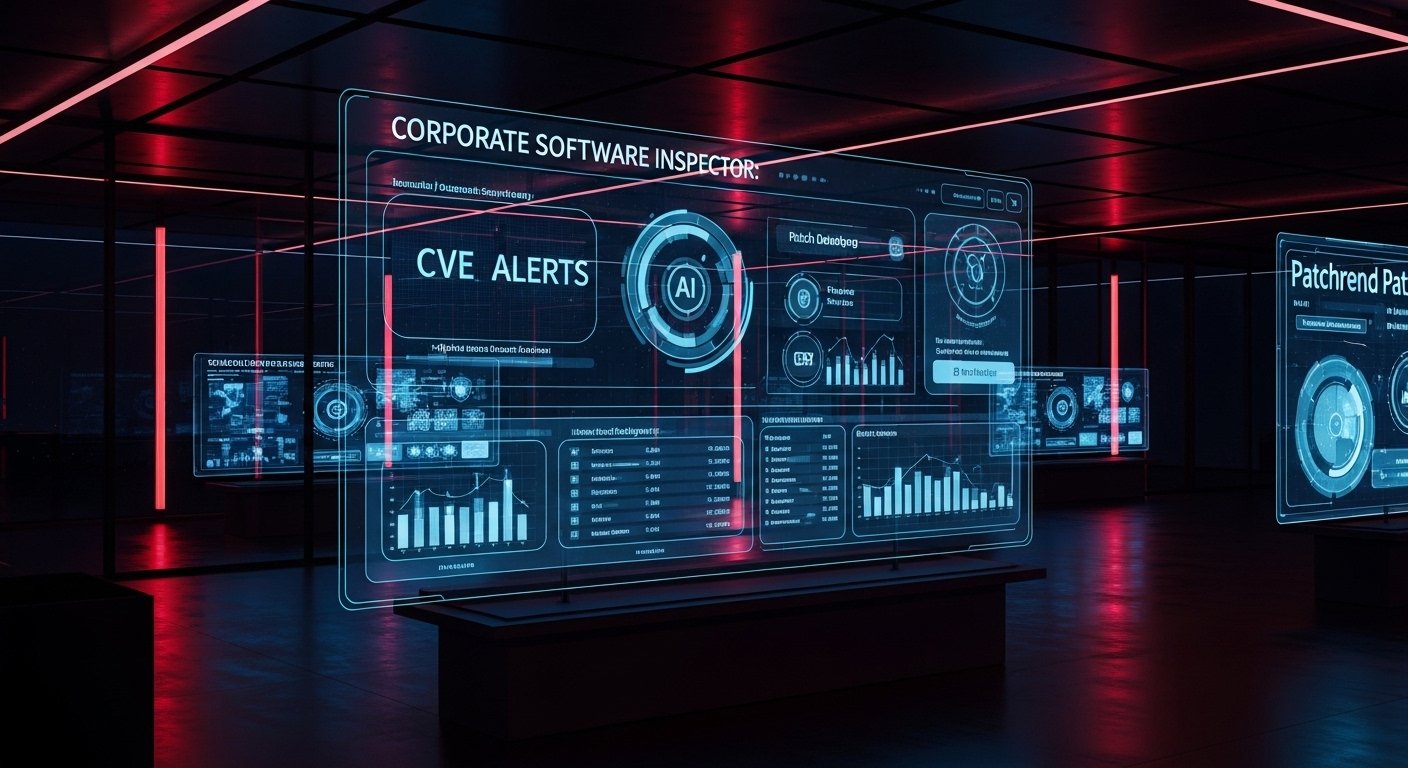
The intersection of digital transformation and systemic cybersecurity risk has birthed a new era of enterprise governance, where the integrity of a company’s software ecosystem is no longer a secondary IT concern but a primary board-level liability. As organizations increasingly rely on a complex web of proprietary, open-source, and third-party applications to drive everything from supply chain logistics to customer experience, the traditional methods of software management have proven inadequate. The rise of the Corporate Software Inspector a term that encapsulates both a sophisticated technological solution and a critical professional role represents a fundamental shift toward proactive, intelligence-driven risk mitigation. In a landscape where the National Vulnerability Database and CISA’s Known Exploited Vulnerabilities (KEV) catalog are expanding at an unprecedented rate, the ability to identify, prioritize, and remediate vulnerabilities before they are exploited is the defining characteristic of a resilient organization.
The urgency of this mission is underscored by the record-breaking publication of over 40,009 Common Vulnerabilities and Exposures (CVEs) in 2024 alone, marking a significant escalation in the volume of potential entry points for malicious actors. With unpatched vulnerabilities implicated in an estimated 60% of all data breaches, and the financial repercussions of failure reaching into the billions—as exemplified by the landmark Equifax breach—the deployment of a dedicated software inspection framework has transitioned from a best practice to a strategic necessity. As the industry moves into 2026, the arrival of agentic artificial intelligence and the commercialization of AI-assisted cybercrime are further complicating the defensive task, requiring a nuanced understanding of how automated inspection tools and human expertise must coalesce to secure the modern enterprise.
The Dual Nature of Corporate Software Inspection: Tool and Profession
To understand the current state of software governance, one must distinguish between the Corporate Software Inspector as an integrated technology platform and as a specialized career path. While they are inextricably linked, each serves a unique function within the broader security architecture of a modern corporation.
The Technological Solution: Mechanisms of Automated Oversight
At its core, a Corporate Software Inspector is an advanced security solution engineered to detect vulnerable programs and facilitate the installation of security updates across vast corporate networks. Platforms like Flexera’s Corporate Software Inspector (formerly known as Secunia CSI) provide a comprehensive Lifecycle for Software vulnerability management, integrating assessment, mitigation, and verification into a single service offering. The mechanism of action for such tools is rooted in authenticated internal software inventory scanning, which allows for an unparalleled level of accuracy by examining the actual state of installed files rather than relying on potentially misleading metadata or unauthenticated network probes.
The breadth of these tools is a critical factor in their effectiveness. Modern enterprise environments are rarely homogenous, typically comprising a mix of Microsoft Windows, Apple macOS, and Red Hat Enterprise Linux (RHEL) platforms. A leading software inspector must provide visibility across these diverse operating systems, correlating an organization’s specific software inventory with a continuously updated database of verified vulnerability intelligence. This intelligence, often sourced from specialized entities like Secunia Research, provides the “when, where, what, and how” of security patching—telling IT teams not just that a vulnerability exists, but where it will have the most critical impact and how to deploy the appropriate remediation.
| Core Functional Category | Technological Capability | Strategic Objective |
| Asset Discovery | Multi-platform authenticated scanning for comprehensive inventory | Eliminate visibility gaps in the software estate |
| Risk Assessment | Correlation of local inventory with verified vulnerability intelligence | Prioritize remediation based on exploitability and impact |
| Patch Mitigation | Delivery of pre-configured, tested patch packages for non-Microsoft apps | Reduce manual packaging effort and accelerate time to patch |
| Compliance Verification | Post-remediation rescanning and automated reporting | Provide documented proof of risk reduction for audits |
The Professional Role: The Auditor of the Digital Ecosystem
Parallel to the technology is the emergence of the Corporate Software Inspector as a specialized professional. This role differs significantly from traditional IT administrative or development positions. While a developer focuses on building systems and an administrator on maintaining uptime, the Corporate Software Inspector is tasked with the critical evaluation and auditing of the entire software ecosystem to ensure it operates legally, ethically, and efficiently. They act as the bridge between the technical realities of software vulnerabilities and the high-level requirements of IT governance and risk management.
The responsibilities of this role are expansive, covering the intersection of compliance, security, and financial optimization. A professional in this field must navigate complex regulatory landscapes, such as GDPR, HIPAA, SOX, and PCI-DSS, ensuring that every piece of software in use adheres to both international law and internal corporate policies. This involves not only technical vulnerability assessments but also rigorous software license audits to prevent the legal and financial risks associated with over-usage or unapproved software deployment.
The Drivers of Modern Software Inspection: Risk, Cost, and Compliance
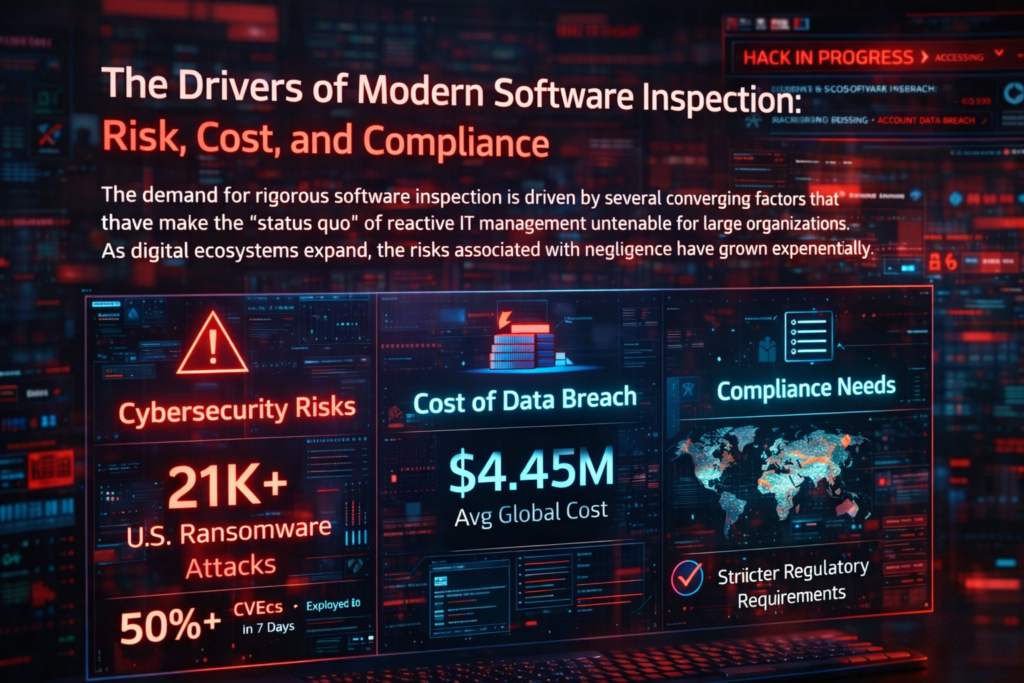
The demand for rigorous software inspection is driven by several converging factors that have made the “status quo” of reactive IT management untenable for large organizations. As digital ecosystems expand, the risks associated with negligence have grown exponentially.
Escalating Cybersecurity Risks and the Triage Firehose
The primary driver for implementing a Corporate Software Inspector is the sheer volume and sophistication of modern cyber threats. In 2024, the Internet Crime Complaint Center (IC3) of the FBI identified more than 21,000 ransomware attacks in the U.S. alone, signaling that vulnerability scanning must move from a periodic task to a preemptive, continuous operation. Furthermore, the speed at which exploits are developed has increased dramatically; more than 50% of CVEs now have exploits published to the dark web within seven days of their discovery.
This rapid timeline creates what experts refer to as a “triage firehose” or a “triage bottleneck”. Organizations are often overwhelmed by the sheer number of security alerts, many of which may be false positives or low-priority items. An intelligent software inspector addresses this by providing risk-based prioritization, allowing security teams to focus on the small percentage of vulnerabilities that are actually being exploited in the wild or that pose a catastrophic risk to business-critical assets.
The Financial Architecture of Software Governance
Beyond security, the implementation of software inspection is a matter of financial prudence. Organizations frequently overpay for software due to poor license tracking or mismanagement, a problem that professional inspectors solve by reconciling entitlements with actual usage. Conversely, the lack of a proper inspection framework can lead to massive audit penalties when vendors discover unlicensed software use during their own reviews.
The return on investment (ROI) for these tools is often realized through a combination of manual labor reduction and risk avoidance. By providing hundreds of pre-configured, tested patches for non-Microsoft applications, a software inspector significantly reduces the manual IT overhead required for software packaging and deployment. Moreover, by decreasing the attack surface risk by up to 80% through automated processes, the tool acts as a strategic investment that prevents the astronomical costs associated with data breach recovery and reputational damage.
| Economic Driver | Impact of Non-Inspection | Benefit of Corporate Inspection |
| Data Breach Costs | Average cost of breach involves millions in remediation and fines | 80% reduction in attack surface risk |
| Audit Penalties | Costly fines for non-compliant license usage | License compliance management prevents penalties |
| Operational Overhead | Weeks spent manually packaging and testing patches | Mean Time to Patch (MTTP) reduced from weeks to days |
| Software Spend | Inefficient allocation and overpayment for unused seats | Resource optimization identifies redundant software |
Technical Implementation and Operational Workflows
For a Corporate Software Inspector to be effective, it must be integrated into a structured, repeatable workflow that aligns IT Operations with Security goals. This lifecycle typically follows a four-phase model: Assessment, Prioritization, Mitigation, and Verification.
Phase 1: Comprehensive Scanning and Discovery
The first step in the inspection process is the creation of a definitive software inventory. This is achieved through authenticated scans, which use administrative credentials to probe the internal state of each machine on the network. This method is superior to agentless or unauthenticated scans because it can identify programs and plugins that are not actively running or that are installed in non-standard directories.
Modern implementations must also account for the shift toward remote and hybrid work. Traditional network-based scanners often miss devices that are not connected to the corporate VPN. Consequently, leading tools utilize lightweight agents that can live on the endpoint and check in with the central console whenever an internet connection is available, ensuring that off-domain laptops do not become “dark” areas in the security posture.
Phase 2: Vulnerability Detection and Prioritization
Once the inventory is established, the inspector correlates this data with a vulnerability database. Each identified application is mapped against known CVEs and assigned a risk score. This phase is where the “intelligence” of the inspector is most visible. Rather than treating all vulnerabilities as equal, the system uses factors such as the Common Vulnerability Scoring System (CVSS), the Exploit Prediction Scoring System (EPSS), and business-specific asset criticality to rank remediation tasks.
Phase 3: Mitigation and Patch Deployment
Mitigation involves the actual remediation of the identified risks. One of the primary advantages of a solution like Flexera’s CSI is its seamless integration with existing deployment infrastructures like Microsoft System Center Configuration Manager (SCCM) and Windows Server Update Services (WSUS). This allows IT teams to manage the patching of non-Microsoft products—such as Chrome, Java, Adobe Reader, and VLC—directly from within their existing Microsoft management console.
Strategic implementation in this phase often involves the use of “pilot rings” or phased rollouts. By deploying patches to a small group of test machines before an enterprise-wide release, inspectors can identify “breaking changes” or application conflicts in a controlled environment.
Phase 4: Rescanning and Verification
The final phase of the workflow is arguably the most important for governance: verification. After patches have been deployed, the inspector performs a rescan to confirm that the vulnerabilities have been successfully remediated. This provides the documented proof required for internal and external audits, ensuring the organization can demonstrate a state of continuous compliance with major frameworks such as ISO 27001 or NIST.
The 2026 Threat Landscape: AI, Quantum, and Identity
As we look toward 2026, the field of corporate software inspection is facing a “seismic shift” in risk dynamics, largely driven by the rapid adoption of artificial intelligence and the looming specter of quantum computing. The year 2026 is being forecasted by industry leaders as the “Year of the Defender,” a time when AI-driven defenses finally begin to tip the scales back in favor of organizations, provided they have the infrastructure to support them.
The Rise of Agentic AI and Autonomous Attackers
One of the most significant trends for 2026 is the emergence of agentic AI—autonomous systems that can act with minimal human input to discover and exploit vulnerabilities. For attackers, this means the ability to conduct social engineering and vulnerability discovery at a scale and speed that was previously impossible. Experts predict that by 2026, autonomous agents will outnumber human users by a ratio of 82:1, creating a new “trust crisis” where it becomes increasingly difficult to distinguish between legitimate machine commands and malicious ones.
The Identity Target and Deepfake Sophistication
As perimeters continue to blur, identity is becoming the primary target for attackers in 2026. The use of real-time AI deepfakes—such as “CEO doppelgängers”—is expected to make traditional authentication methods vulnerable to coercion and deception. In this environment, Corporate Software Inspectors must expand their scope to include identity security and zero-trust architectures, ensuring that every access request is verified regardless of whether it originates from a human or an AI agent.
The Quantum Imperative and Data Trust
A secondary but equally critical concern for 2026 is the “harvest now, decrypt later” threat. AI is accelerating the timeline for quantum computing, shrinking the window for secure classical encryption. This has led to an industry urgency for Post-Quantum Cryptography (PQC), with the global industry expected to grow from $0.42 billion in 2025 to $2.84 billion by 2030. Software inspectors will play a vital role in this migration by identifying legacy encryption protocols across the software estate that must be updated to quantum-resistant standards.
| Trend Area | 2026 Prediction | Defensive Requirement |
| AI Offense | Widespread use of AI to automate exploit generation | Continuous Exposure Management (CEM) over traditional scans |
| Identity | Deepfakes bypass traditional MFA via “CEO doppelgängers” | AI-driven NLP detection for communication tone and intent |
| Quantum | Shrinking timeline for quantum-ready decryption | Rapid migration to Post-Quantum Cryptography (PQC) |
| Shadow AI | Ungoverned AI tools create systemic data exposure risks | Unified platforms to cover disconnects between data science and security |
Troubleshooting and Technical Resilience
Implementing an enterprise-grade software inspector is a complex undertaking that often encounters technical hurdles. Success requires a deep understanding of agent communication, network protocols, and the nuances of various operating systems.
Resolving Scan Failures and Communication Errors
The most common issues in software inspection involve failures in the scanning process itself. These are typically categorized by specific status results in the management console. For example, a “Failed: License Limit Reached” status indicates that the organization has exceeded its host quota, requiring either a database cleanup of retired machines or the purchase of additional licenses.
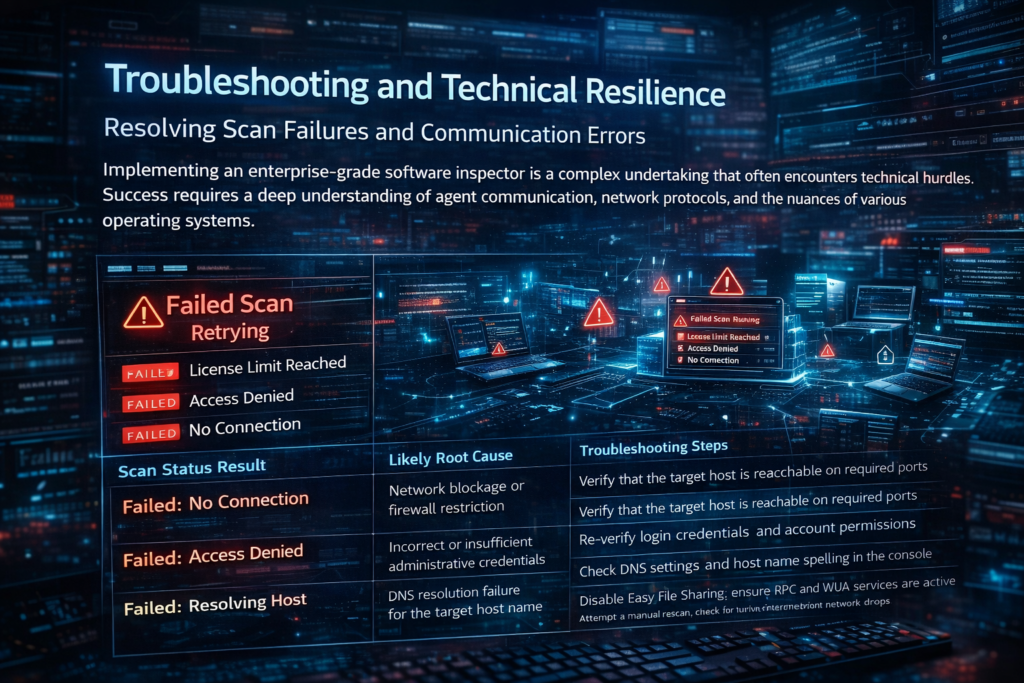
Connectivity problems are frequently the result of firewall configurations or RPC service failures. If an inspector reports a “Partial: Windows Update Failed” status, it suggests that while the third-party scan was successful, the system was unable to communicate with the local Windows Update Agent (WUA) due to firewalled RPC ports or incorrect administrative credentials.
| Scan Status Result | Likely Root Cause | Troubleshooting Steps |
| Failed: No Connection | Network blockage or firewall restriction | Verify that the target host is reachable on required ports |
| Failed: Access Denied | Incorrect or insufficient administrative credentials | Re-verify login credentials and account permissions |
| Failed: Resolving Host | DNS resolution failure for the target host name | Check DNS settings and host name spelling in the console |
| Partial Success | “Easy File Sharing” enabled or local RPC down | Disable Easy File Sharing; ensure RPC and WUA services are active |
| Communications Error | Temporary network instability between agent and host | Attempt a manual rescan; check for intermittent network drops |
Managing Agent Performance in Large Environments
In massive, global enterprises, agent performance can be affected by network latency and server load. To address this, organizations often deploy “Inventory Gateways” at remote sites or regional hubs (e.g., EMEA or APAC). This approach reduces the burden on the central server and allows for faster deployment of updates and more reliable scan check-ins. Furthermore, ensuring that agents are updated to use modern protocols like TLS 1.2 is essential for both security and successful communication with the central management server.
The Competitive Landscape: Benchmarking Software Inspection Tools
The market for vulnerability and software asset management is populated by several high-tier competitors. While Flexera’s CSI is a leader in integrated patch management, other platforms offer specialized strengths in cloud security, endpoint detection, or ease of deployment.
Flexera vs. the Market: A Comparative Analysis
Recent reviews from Gartner and other industry analysts suggest that while Flexera is often rated higher for service, support, and contracting, competitors like Tenable and Qualys are praised for their unified platforms and AI-powered exposure management capabilities. For instance, Tenable Nessus is highly regarded for its detection accuracy across modern attack surfaces, while Qualys VMDR is recognized for its ability to serve as a “single source of truth” for all vulnerability information.
| Feature Comparison | Flexera SVM/CSI | Qualys VMDR | Tenable Nessus | Rapid7 InsightVM |
| Strongest Platform | Windows, macOS, RHEL | Cloud-native, All OS | Hybrid/Cloud Exposure | Multi-cloud/DevOps |
| Primary Differentiator | Deep SCCM/WSUS Patching | Single agent architecture | AI-powered risk scoring | Actionable risk insights |
| Market Sentiment | Better service/support | Simplistic UI for hardening | Leader in detection depth | Reliable in complex clouds |
| Patch Management | Native, pre-configured | Integrated patching | Remediation orchestration | Automated workflows |
In the specialized realm of software asset management (SAM) and license compliance, Flexera maintains a significant advantage by being the only tool alternative certified by IBM for license compliance reporting, which can eliminate the need for multiple tools in complex IBM-heavy environments. Additionally, Flexera’s Technopedia catalog, which normalizes over 2.13 million SKUs and 22.5 million OSS components, provides a level of data enrichment that is difficult for smaller competitors to match.
Addressing the “Invisible” Threat: Shadow IT and Shadow AI
One of the most pervasive challenges for a Corporate Software Inspector is the growth of Shadow IT—software and services used by employees without explicit IT approval. In 2025 and 2026, this problem is exacerbated by “Shadow AI,” where employees utilize unauthorized generative AI tools for data analysis or content creation, often inadvertently exposing sensitive corporate data to third-party models.
Strategies for Detection and Reclamation
The detection of Shadow IT requires a multi-layered approach that goes beyond traditional inventory scans. Effective strategies include:
- Network Traffic Analysis: Identifying unusual data flow patterns or encrypted traffic metadata that points to unauthorized cloud service usage.
- Browser Extension Monitoring: Tracking the installation of browser-based tools, which often request excessive permissions and can bypass endpoint-level software inventories.
- Expense Report Analysis: Reviewing financial records to identify software subscriptions purchased by individual employees or departments via reimbursement.
- CASB Integration: Using Cloud Access Security Brokers to act as a gatekeeper between the corporate network and cloud service providers, identifying and blocking connections to unapproved apps in real-time.
By identifying and consolidating these unauthorized applications, Corporate Software Inspectors can not only improve the organization’s security posture but also significantly reduce costs by eliminating redundant subscriptions and right-sizing license allocations.
Best Practices for a Security-First Development Culture
The ultimate goal of corporate software inspection is to move security “left” in the software development lifecycle (SDLC). This means identifying and remediating vulnerabilities as early as possible—ideally before code is even committed to production.
Integrating Security into the SDLC
To achieve this, organizations are adopting a set of core best practices:
- Early Integration: Using Static Application Security Testing (SAST) and Software Composition Analysis (SCA) tools during the development phase to catch flaws in both custom code and third-party dependencies.
- Continuous Monitoring: Moving away from quarterly or monthly scans in favor of real-time visibility and continuous exposure management (CEM).
- Collaborative Responsibility: Fostering an environment where developers, operations, and security teams share accountability for software integrity, rather than treating security as a final “checkpoint” that delays deployment.
- Prioritized Action: Using intelligence-led risk scoring to ensure that teams are not overwhelmed by low-priority alerts, but instead act immediately with hotfixes for critical, exploitable vulnerabilities.
The data from 2024 and 2025 suggests that organizations that successfully integrate these practices—such as through the use of pilot rings and automated patch verification—can achieve a 50% reduction in their unpatched vulnerability count within just three months of implementation.
Conclusion: The Strategic Path Forward
The role of the Corporate Software Inspector has evolved from a technical necessity into a strategic imperative for the modern enterprise. As we navigate the complex threat landscape of 2026—characterized by autonomous AI agents, quantum risks, and the pervasive growth of Shadow IT—the ability to maintain a clear, authenticated view of the software estate is the primary line of defense. The financial and reputational consequences of failure are no longer hypothetical; they are documented in the massive data breaches and regulatory fines that have defined the early 2020s.
A successful software inspection program requires a synthesis of advanced technology and professional expertise. Tools like Flexera’s CSI provide the essential data and deployment mechanisms, but it is the Corporate Software Inspector professional who must interpret this data, manage the organizational change, and ensure that software governance aligns with the overarching goals of the business. By moving toward a model of continuous exposure management and risk-based prioritization, organizations can not only secure their digital foundations but also drive operational efficiency and financial optimization in an increasingly volatile digital world. The path forward is one of vigilance, automation, and a relentless commitment to the integrity of the digital ecosystem.
FAQ’s
A Corporate Software Inspector is an enterprise security solution and professional role focused on identifying, assessing, and remediating software vulnerabilities across an organization’s entire IT environment. It ensures continuous visibility, compliance, and risk reduction by combining automated scanning with expert governance.
Software inspection is critical in 2026 due to the rapid rise of AI-driven cyberattacks, agentic AI threats, and the growing volume of CVEs. With over 40,000 vulnerabilities disclosed annually and exploits appearing on the dark web within days, proactive inspection is essential for enterprise resilience.
Traditional scanners perform periodic or surface-level checks, while a Corporate Software Inspector uses authenticated, continuous scanning, risk-based prioritization, and automated patching. It focuses on real exploitability, compliance proof, and lifecycle governance rather than raw alert volume.
A Corporate Software Inspector helps organizations:
Reduce cyber risk and attack surface
Prevent ransomware and data breaches
Maintain license compliance and avoid audit penalties
Automate patch management
Identify Shadow IT and Shadow AI usage
Support regulatory compliance (ISO, GDPR, HIPAA, PCI-DSS)