

The global labor market in 2026 is currently undergoing a structural transformation that historians will likely characterize as the dawn of the Intelligence Age. This era represents a decisive shift from the experimental phase of artificial intelligence to its integration as a core operational capability across nearly every sector of the global economy. For individuals entering the workforce or transitioning from traditional technology roles, the landscape is defined by a paradox of unprecedented opportunity and significant disruption. The traditional career playbooks, once centered on linear progression and isolated technical skills, are being replaced by an ecosystem that prioritizes outcome-oriented work, domain specialization, and the orchestration of complex AI-augmented systems.
The demand for AI expertise is no longer restricted to a handful of Silicon Valley tech giants. Companies ranging from traditional manufacturing in Munich to agricultural startups in Vietnam are aggressively seeking professionals who can bridge the gap between abstract algorithmic capabilities and tangible business outcomes. This maturation of the AI ecosystem has resulted in the emergence of a diverse taxonomy of roles, spanning highly technical engineering positions to hybrid functions focused on ethics, governance, and creative synthesis. Consequently, the “early career” phase in AI has become a multidimensional journey requiring a blend of deep technical mastery, strategic networking, and a nuanced understanding of the physical and digital infrastructure that powers the intelligence economy.
The Evolutionary Taxonomy of AI Careers
The AI labor market of 2026 is significantly more specialized than the generalist landscape of the early 2020s. As organizations move from experimentation to scale, the need for distinct professional archetypes has become apparent. Understanding the nuances of these roles is essential for early-career entrants to align their skill sets with specific market demands.
Primary Technical Foundations
At the core of the AI workforce remain the technical roles that design, train, and deploy the models themselves. The distinction between a Machine Learning (ML) Engineer and an AI Engineer, for instance, has become more pronounced. While the ML Engineer typically focuses on the mathematical design and optimization of models, the AI Engineer is increasingly viewed as a product-focused professional who integrates large language models (LLMs) and vector databases into functional applications.
| Job Title | Focus Area | Primary Technical Stack | Entry-Level Salary Range (USD) |
| Machine Learning Engineer | Model design and evaluation | Python, PyTorch, TensorFlow, Keras | $110,000 – $150,000 |
| Data Scientist | Statistical insights and modeling | SQL, R, Pandas, Tableau, Spark | $120,000 – $160,000 |
| Generative AI Engineer | Fine-tuning and deploying LLMs | Hugging Face, OpenAI API, LoRA | $140,000 – $160,000 |
| Computer Vision Engineer | Image and video processing | OpenCV, CNNs, YOLOv8 | $120,000 – $150,000 |
| NLP Engineer | Language understanding systems | SpaCy, NLTK, Transformers | $130,000 – $160,000 |
| Deep Learning Engineer | Neural network architecture | CUDA, Cloud Computing, Neural Nets | $150,000 – $180,000 |
| Data Engineer | Infrastructure and ETL | Spark, Hadoop, NoSQL, AWS/Azure | $110,000 – $130,000 |
This technical taxonomy is supported by a rising demand for specialized engineers who can manage the lifecycle of these models. The role of the MLOps Engineer, for example, has become critical as companies realize that deploying a model is only the beginning; maintaining its performance and ensuring it does not “drift” over time requires a specialized set of skills in CI/CD pipelines and infrastructure monitoring.
Non-Technical and Strategic Hybrid Roles
One of the most significant trends in 2026 is the expansion of the AI labor market into non-technical and hybrid domains. This shift is driven by the realization that AI success is as much about governance, ethics, and product strategy as it is about coding.
The role of the AI Product Manager has become particularly vital. These professionals are tasked with translating complex business problems into model objectives, ensuring that the technical output aligns with the strategic goals of the organization. They must possess enough technical fluency to communicate with engineers while maintaining the soft skills necessary to lead cross-functional teams and manage stakeholder expectations.
Furthermore, as global regulatory frameworks like the EU AI Act become fully operational, the demand for AI Ethical Compliance Officers and Regulatory Compliance Analysts has surged. These roles involve auditing models for bias, ensuring transparency in decision-making algorithms, and navigating the complex legal landscape of data privacy.
| Job Title | Core Responsibility | Key Skill Sets | Typical Entry Point |
| AI Product Manager | Technical strategy and roadmap | Agile, Project Management, EQ | Business/Tech Hybrid |
| AI Ethical Compliance Officer | Bias audit and safety standards | Law, Philosophy, Data Science | Legal or Ethics Background |
| AI Security Analyst | Adversarial defense and safety | Cybersecurity, Threat Modeling | Cybersecurity Background |
| AI Research Assistant | Supporting algorithmic breakthroughs | Academic research, Python | Master’s or PhD Candidate |
| Generative AI Content Creator | Media synthesis and prompting | Prompt Engineering, Creative Direction | Creative/Media Background |
These hybrid roles demonstrate that the AI economy is increasingly accessible to those without traditional computer science degrees, provided they can master the interface between human needs and machine capabilities.
Global Economic Benchmarks and Regional Hubs
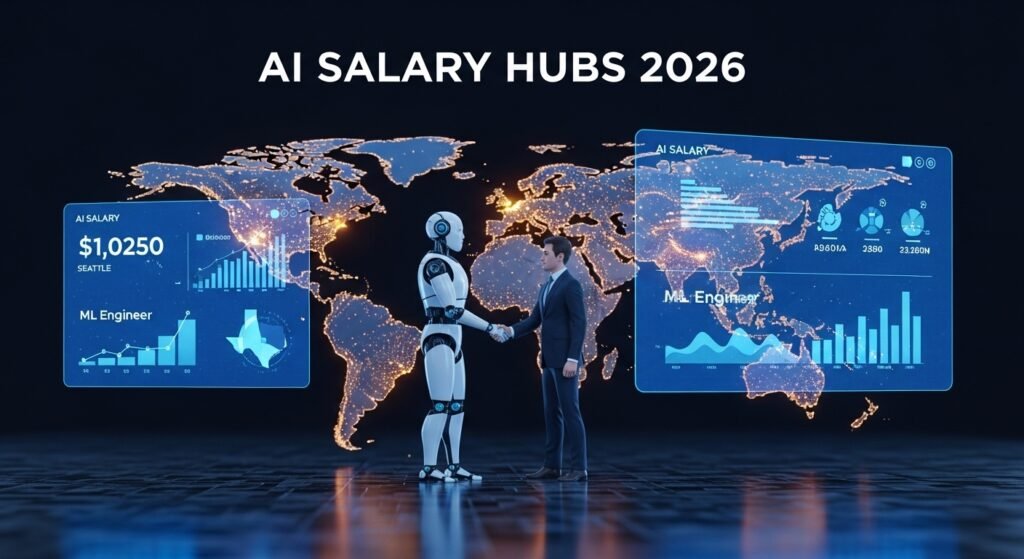
The economic rewards for early-career AI professionals are substantial, but they vary significantly based on geography and industry concentration. By 2026, several global cities have established themselves as dominant hubs, each with its own specialized labor market and salary expectations.
North American Market Dominance
The United States continues to lead the world in peak compensation for AI roles, particularly in the San Francisco Bay Area and Seattle. In these regions, the competition for top-tier talent has pushed salaries to levels that often surpass the national average for standard software engineering by over 20%.
| Location | Role | Average Base Salary (USD) | Total Compensation Estimate |
| San Francisco, CA | Machine Learning Engineer | $218,601 | $290,000+ |
| San Francisco, CA | AI Engineer | $246,250 | $320,000+ |
| Washington State | Machine Learning Engineer | $175,132 | $210,000+ |
| Texas | Machine Learning Engineer | $152,612 | $185,000+ |
| California (National) | Junior ML Engineer | $140,000 | $170,000 |
In the Silicon Valley ecosystem, compensation is increasingly tied to the ability to work with agentic systems and large-scale infrastructure. Professionals with fewer than two years of experience are frequently commanding base salaries in excess of $140,000, particularly if they demonstrate proficiency in high-leverage areas like RAG (Retrieval-Augmented Generation) and model evaluations (evals).
The European Landscape: Frankfurt and London
In Europe, the AI labor market is heavily influenced by the financial and regulatory sectors. London remains the preeminent hub for AI startups, while Frankfurt has solidified its position as the leader for AI in finance and enterprise infrastructure.
In Frankfurt, the average gross salary for an AI Architect has reached approximately €120,736, reflecting the high value placed on individuals who can design secure, compliant systems for the banking sector. Junior IT specialists in the region typically start with salaries around €65,800, which is significantly higher than the average for standard software roles in Germany.
| City | Junior Salary (Local Currency) | Senior Salary (Local Currency) | Market Characteristic |
| Frankfurt, Germany | €65,800 | €149,972 | Financial Services / FinTech |
| London, UK | £67,201 | £110,000+ | Diverse AI Startups / Retail |
| Berlin, Germany | €58,000 | €120,000 | SaaS / Creative Tech |
| Munich, Germany | €62,000 | €138,000 | Automotive / Manufacturing |
The “German OpenAI,” Aleph Alpha, based in Heidelberg, exemplifies the regional shift toward explainable and compliant AI systems, a trend that is driving a niche but high-paying market for researchers and engineers focused on transparency.
Emerging Opportunities in the Asia-Pacific Region
The Asia-Pacific region is witnessing a rapid expansion of its AI talent base, driven by significant government investment and a focus on the semiconductor hardware that powers AI systems.
In India, the AI talent base has recorded the largest increase among major economies between 2016 and 2024. Major employers like Accenture, Tiger Analytics, and Quantiphi are offering salaries ranging from ₹11,00,000 to ₹15,00,000 for experienced AI professionals, which represents a massive premium over the national average salary.
Vietnam has also emerged as a critical player, particularly in the semiconductor space. The country’s semiconductor market is projected to grow significantly by 2026, creating tens of thousands of roles for engineers involved in IC design and process engineering.
| Country | Role | Monthly Salary Range (Local) | Outlook |
| Vietnam | AI/ML Engineer | 30M – 125M VND | High Growth in Apps |
| Vietnam | Data Scientist | 25M – 100M VND | Healthcare & Education |
| Vietnam | IC Design Engineer | 15M – 35M VND | Semiconductor Boom |
| India | AI Specialist | ₹15,00,000 (Annual) | Rapid Talent Expansion |
Mastering the Technical Foundation for 2026
To be successful in the 2026 AI labor market, early-career professionals must move beyond surface-level knowledge. The field has matured to a point where “knowing how to prompt” is a baseline skill, not a competitive advantage. The focus has shifted back to fundamental engineering principles and advanced programming concepts.
Programming and Mathematics
Python remains the undisputed language of AI, but the requirements for mastery have changed. Experts emphasize the importance of understanding asynchronous programming (asyncio) and memory management to handle the high-throughput requirements of production AI systems. Furthermore, a deep understanding of mathematics—specifically linear algebra, calculus, and probability—is essential for understanding how backpropagation and loss functions operate.
A standard curriculum for an aspiring AI engineer in 2026 includes:
- Mathematics: Calculus for gradient descent, linear algebra for tensor operations, and statistics for model evaluation.
- Programming: Python mastery, including libraries like NumPy, Pandas, and deep learning frameworks like PyTorch or TensorFlow.
- Architecture: Understanding transformer models, attention mechanisms, and the basics of neural networks.
The Shift to Agentic AI and Workflow Orchestration
One of the most profound technical shifts in 2026 is the transition from “chatbots” to “agents.” While early AI applications were essentially reactive, agentic systems are proactive—they can plan tasks, use tools (APIs, databases), and iterate on their own processes to achieve a goal.
For early-career entrants, this means mastering “workflow orchestration.” This involves designing systems that connect an LLM to external data sources and defining the “guardrails” that keep the agent on task. For instance, an agentic RAG system doesn’t just retrieve information; it evaluates the quality of the retrieved data, decides if it needs more information, and then synthesizes the final answer.
The technical stack for agentic AI often includes:
- Vector Databases: Pinecone, Milvus, or Weaviate for efficient information retrieval.
- Orchestration Frameworks: LangChain, LangGraph, or CrewAI for managing multi-agent interactions.
- Evaluations (Evals): Using tools like LangSmith to systematically test and measure the accuracy of agentic outputs.
Strategic Marketability and Portfolio Development
In a job market where AI itself is being used to screen resumes, standing out requires a strategic approach to personal branding and portfolio development. The focus has shifted from “volume of projects” to “depth and domain expertise”.
The Concept of Domain Arbitrage
Domain Arbitrage is the practice of combining AI technical skills with deep expertise in a non-technical field, such as real estate, fashion, or healthcare. This makes an engineer significantly more valuable because they can solve specific business problems rather than just building generic tools.
A prominent example is the “Condo GPT” project. An aspiring AI engineer with a background in real estate built a specialized agent that could navigate complex property regulations and market data. Despite having less technical experience than other candidates, this “domain expertise” led to high-paying offers from PropTech (Property Technology) firms because the candidate proved they understood the industry’s unique pain points.
Building a 2026-Ready Portfolio
Recruiters in 2026 are looking for proof of “real-world problem-solving.” A strong portfolio should include three to five well-documented, deployed projects rather than a dozen half-finished repositories.
| Project Idea | Key Technologies | Demonstration of Skill |
| Agentic RAG Assistant | LangGraph, Vector DB, Python | Orchestration and retrieval logic |
| Multimodal Summarizer | Whisper, GPT-4V, Streamlit | Handling diverse data types (Audio/Video) |
| Finetuned Domain Model | LoRA, QLoRA, Hugging Face | Model optimization and niche application |
| Autonomous Trading Bot | APIs, Real-time data, ML | Real-time decision making and risk mgmt |
| AI Compliance Auditor | NLP, Legal DBs, Python | Ethics, bias detection, and safety |
Each project in the portfolio should include a comprehensive README that explains the architecture, the “why” behind specific tool choices, and clear instructions for deployment.
Leveraging the YouTube Educational Ecosystem
YouTube has evolved into a primary learning platform for AI professionals, providing real-time updates that academic curricula often miss. Early-career entrants are encouraged to follow specific experts who provide high-quality, practical advice.
- Ken Jee: Focuses on the “Kaggle” ecosystem and provides advice on building data science projects that lead to jobs.
- Tina Huang: Offers detailed roadmaps for AI engineering and emphasizes the importance of learning agentic workflows.
- Krish Naik: Known for deep-dive “complete roadmaps” that cover statistics and machine learning implementation from scratch.
- 3Blue1Brown (Grant Sanderson): Essential for visualizing the complex mathematics behind neural networks and linear algebra.
The Physical Backbone: Infrastructure and Skilled Trades
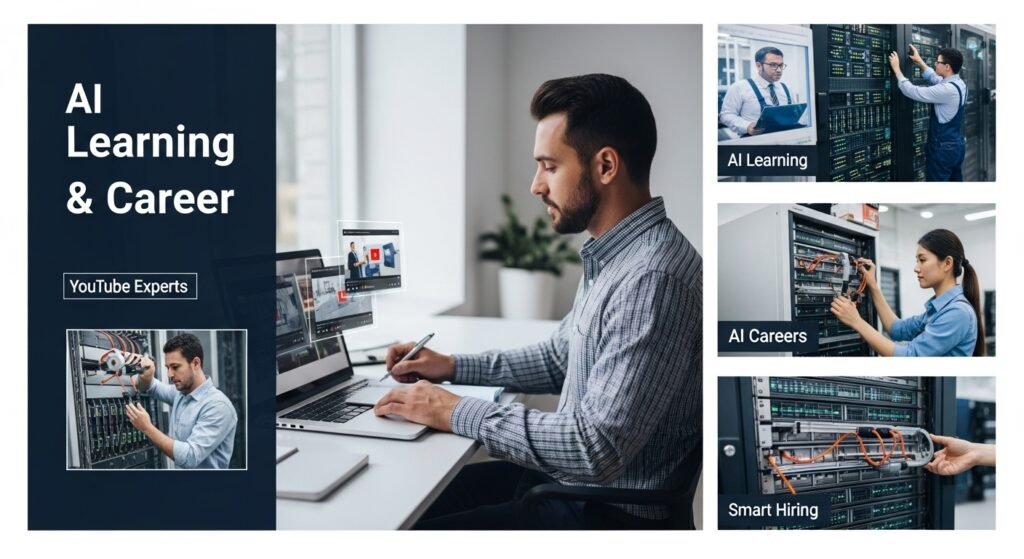
A common misconception is that the “AI revolution” only benefits those sitting behind computer screens. However, the Intelligence Age requires a massive expansion of physical infrastructure—data centers, power grids, and chip manufacturing plants—which has created a new class of high-paying “blue-collar” AI careers.
Jensen Huang’s Thesis on Skilled Trades
Nvidia CEO Jensen Huang has observed that the current era represents the largest infrastructure build-out in human history. This has led to a surge in demand for plumbers, electricians, network technicians, and equipment installers to build and maintain the “AI factories”.
In early 2024, Gen Z accounted for nearly 25% of new hires in these skilled trade roles. These positions are becoming increasingly lucrative, with salaries in some cases crossing the six-figure mark. Crucially, these roles are viewed as more “AI-resistant” because they involve complex physical tasks in non-standard environments that robots cannot yet navigate.
| Role | Impact on AI | Automation Resilience |
| Electrician | Powering massive GPU clusters | High – Physical complexity |
| Network Technician | Low-latency fiber installation | High – Hardware maintenance |
| HVAC Specialist | Cooling high-density server racks | High – Critical infra |
| Process Engineer | Semiconductor manufacturing | Moderate – High precision |
This trend highlights a broader economic reality: the AI boom is not just a software shift; it is a fundamental re-architecture of our physical world, rewarding those who can build the systems as much as those who can code them.
The Transformation of Recruitment and Hiring
Hiring in 2026 is no longer a human-only endeavor. Organizations are increasingly using AI to handle the volume and complexity of technical recruiting, which has significant implications for how early-career professionals should approach their job search.
The AI Recruiter Playbook
Modern recruitment platforms have moved beyond simple keyword matching. AI recruiters in 2026 are “context-aware,” evaluating the depth of a candidate’s experience, the relevance of their open-source contributions, and even their behavioral patterns during asynchronous interviews.
Companies are looking for “Repeatable Decision Packages”—data-driven summaries that rank candidates based on:
- Skill relevance beyond job titles.
- Experience depth and transferability of technical skills.
- Problem-solving ability demonstrated through code and video interviews.
For the candidate, this means that their online presence—GitHub, LinkedIn, and personal website—must be “machine-readable” and consistently updated. AI tools can now scan public databases to identify passive candidates who may be the “best fit” for a role even if they haven’t applied.
Failure Drills and Overrides
Hiring managers are also being trained to “break the workflow” of AI recruiters to ensure fairness and accuracy. This involves:
- Manual Overrides: Humans intervention when an AI screens out a candidate who might have “niche” but highly valuable experience.
- Bias Audits: Regular checks to ensure the AI recruiter is not replicating historical biases in hiring patterns.
- Human Escalation: Ensuring that candidates always have a path to speak to a human when nuance is required.
This “human-in-the-loop” recruitment process ensures that while AI handles the scale, humans retain authority over the final decision, particularly for senior or high-stakes roles.
Institutional Support: Fellowships, Mentorships, and Policy
Navigating the early stages of an AI career is often made easier by participating in established institutional programs. These offer structured learning, mentorship, and a direct path to employment.
Policy and Research Fellowships
For those interested in the governance of AI, the IAPS AI Policy Fellowship offers a fully-funded three-month program. Fellows work on independent policy projects under the mentorship of leading experts in the field, with alumni moving on to roles in organizations like the Future Society and the Institute for Progress.
Diversity and Early College Initiatives
Programs like AI4ALL Ignite provide no-cost virtual accelerators for college students, specifically focusing on connecting underrepresented groups with industry mentors. Similarly, MIT FutureMakers is a six-week summer program that trains high school and early college students to use AI for social good, emphasizing leadership and entrepreneurial skills.
These programs are essential for ensuring that the AI workforce of 2026 is diverse and capable of addressing the complex social challenges posed by automation.
Navigating the “Decoupling” Economy
As we settle into 2026, a “quiet revolution” is rewriting the global services economy. The defining characteristic of an “AI-native” company is the decoupling of revenue growth from headcount growth. In traditional companies, growing the business required hiring more people. In AI-native companies, revenue can scale exponentially while the human core remains small and highly leveraged.
This shift has profound implications for early careers:
- Small Teams, Big Leverage: Early-career professionals are expected to do more with less. Instead of being part of a 50-person QA team, a single “Automation Engineer” might manage an entire agentic testing suite.
- Outcome over Hours: The “labor arbitrage” model of the past—paying people for their time—is being replaced by “intelligence arbitrage,” where people are paid for the outcomes they orchestrate.
- Intelligence Arbitrage: Companies now choose between clinging to old labor models or pivoting to intelligence arbitrage, where value is created by the speed of experimentation and decision-making.
This “decoupling” means that entry-level roles are becoming more “managerial” in nature. A junior engineer in 2026 is often not writing every line of code; they are managing a small fleet of AI agents that are writing the code, and their job is to ensure the output is correct, secure, and aligned with the goal.
Conclusion: Strategic Advice for the Intelligence Age
The transition to a career in AI in 2026 requires a fundamental mindset shift. The evidence suggests that while technical skills remain the foundation, the true competitive advantage lies in the ability to solve complex, non-linear problems using a combination of human intuition and machine intelligence.
Final Recommendations for Early-Career Entrants
- Embrace “Agentic” Thinking: Do not just learn to use AI; learn to build systems that use AI to execute entire workflows. Mastery of orchestration frameworks like LangGraph or CrewAI will be a major differentiator.
- Specialize Early through Domain Arbitrage: Combine your technical AI skills with a specific industry (healthcare, finance, real estate). Being “the AI person for real estate” is a much stronger position than being a “generic data scientist”.
- Build in Public and Maintain a Working Portfolio: High-quality, deployed projects on GitHub with clear documentation and video demos are the most effective way to bypass automated recruitment filters.
- Focus on “AI-Resistant” Human Skills: As routine cognitive tasks are automated, the value of EQ, leadership, creative synthesis, and ethical judgment will only increase. These are the skills that allow you to manage AI systems rather than being replaced by them.
- Leverage Alternative Education and Mentorship: Stay updated via YouTube roadmaps from experts like Ken Jee and Tina Huang, and seek out fellowship programs like IAPS or AI4ALL to build your network.
The AI labor market of 2026 is not just a destination for elite researchers; it is a broad and diverse ecosystem that rewards those who are adaptable, technically grounded, and strategically focused on solving real-world problems. In this new era, the most successful professionals will be those who view AI as the ultimate force multiplier, allowing them to achieve in their early careers what once required decades of experience.
Python, advanced mathematics, AI architectures, and agentic workflow orchestration are key.
San Francisco, Seattle, London, Frankfurt, Berlin, Mumbai, and Hanoi lead in compensation.