
The modern corporate world faces a paradox: organizations generate more data than ever, yet their ability to retrieve and use it effectively known as institutional memory has become increasingly fragmented. This fragmentation creates an “information tax,” where employees spend significant portions of their workday navigating multiple platforms to find verified information or, failing that, interrupt colleagues to fill knowledge gaps. Research indicates that such silos and context switching can reduce task efficiency by 15–25%, limiting the scalability of fast-growing enterprises.
Guru knowledge base software addresses these challenges, evolving from a simple repository into an AI-powered “Source of Truth” that delivers verified, contextually relevant information directly within employees’ workflows.
From Static Wikis to Governed Knowledge Ecosystems
Traditional corporate wikis allowed anyone to contribute or edit content, encouraging collaboration but often leading to content rot—outdated, disorganized, or contradictory information that erodes trust. Guru solves this by combining the collaborative ease of a wiki with the governance of a formal knowledge base. Its card-based structure breaks information into modular units focused on a single topic, policy, or procedure.
| Feature | Corporate Wiki | Guru Knowledge Base (2025-2026) |
|---|---|---|
| Governance | Decentralized, community-maintained | Expert-owned with automated verification workflows |
| Content Granularity | Long-form, nested pages | Bite-sized Knowledge Cards |
| Search | Keyword-reliant | Semantic AI search with intent matching |
| Workflow Integration | Static; requires context switching | Embedded in Slack, MS Teams, browser extensions |
| Maintenance | Manual, often neglected | AI-driven auto-maintenance and verification |
| Engagement Tracking | Limited | Detailed usage and knowledge gap dashboards |
By implementing this structure, Guru eliminates the “hamster wheel” of maintenance. Each Card has an assigned owner, and automated schedules ensure content remains accurate and trustworthy.
AI Knowledge Agents and the Model Context Protocol
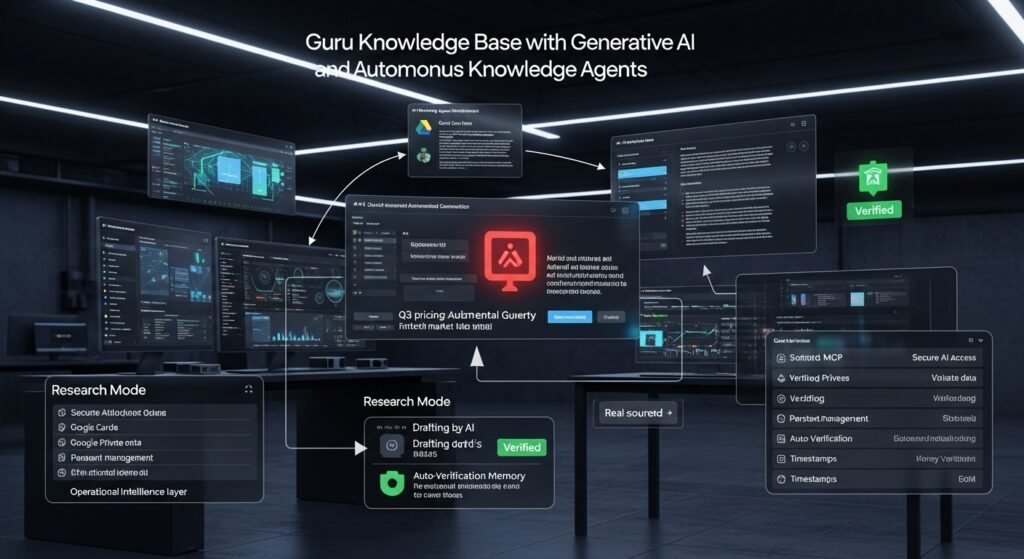
The most significant innovation from 2024 to 2026 is the integration of Generative AI and autonomous Knowledge Agents. These agents actively synthesize information by indexing multiple company sources—including Guru Cards, Google Drive, Salesforce, Confluence, and Slack transcripts—to provide conversational, cited answers to complex queries.
Agents use Retrieval-Augmented Generation (RAG): they analyze a user’s intent, retrieve relevant information, and synthesize it into a natural-language response. Research Mode allows combining internal company data with live web search. For instance, a sales rep asking, “How does our Q3 pricing compare to fintech market trends?” receives a comprehensive answer with verified company data and external market context—all without leaving their CRM.
Guru’s Model Context Protocol (MCP) enables secure AI access to private enterprise data. This ensures AI answers are grounded in verified organizational knowledge, preventing hallucinations.
| Feature | Plugin/Custom GPT | Guru MCP Server (2026) |
|---|---|---|
| Interoperability | Platform-locked | Open standard; works with ChatGPT, Claude, and more |
| Security/Privacy | Data may be used for training | Permission-aware; data never used publicly |
| Execution | Read-only | Supports creating/updating Cards or tickets |
| Context Management | Fixed windows | Persistent memory across channels |
Automated Verification: Operationalizing Trust
Trust is critical. Guru enforces it through an automated verification engine:
- Drafting & AI Assistance: Content is created by a team member or AI.
- Expert Assignment: Each Card is assigned to a subject matter expert (SME).
- Verification & Timestamping: Verified Cards display a “Verified” badge for immediate confidence.
- Automated Decadence: Cards expire automatically, prompting SME review.
- Auto-Verify (2026): Frequently used Cards without user flags may have their verification extended automatically.
External sources like Google Drive and SharePoint can also be included in this verification cycle, ensuring all organizational knowledge remains trusted.
Reducing the “Information Tax”
Switching between tools reduces productivity and risks using outdated information. Guru’s browser extension functions as a digital companion, surfacing relevant Cards based on on-screen context.
Example: A support agent viewing a “refund policy” ticket automatically sees the verified procedure, eliminating tab-switching and reducing time-to-resolution.
Productivity Impact Example:
- 500 employees save 15 minutes/day
- Annual gain: 32,500 hours
- Monetary value: $1.625 million/year
New hires also onboard faster, reducing training time by 35%.
90-Day Implementation Roadmap
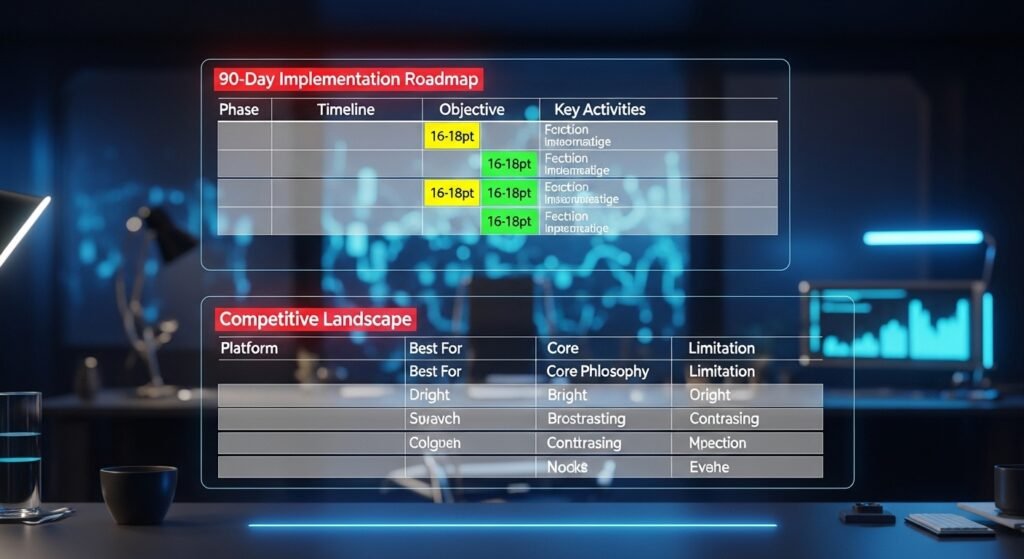
| Phase | Timeline | Objective | Key Activities |
|---|---|---|---|
| Audit & Planning | Days 1-30 | Identify knowledge gaps | Support ticket analysis, SME interviews |
| Pilot Program | Days 31-60 | Operationalize one department | Convert docs to Cards, Slack integration, browser extension |
| Governance Setup | Days 45-75 | Establish verification workflows | Assign verifiers, set verification cadence |
| Company-Wide Rollout | Days 75-90 | Scale & integrate AI Agents | Launch Agents, train teams, monitor analytics |
Content Gardening ensures ongoing structure: archiving old Cards, merging duplicates, and creating content for knowledge gaps detected by analytics.
Competitive Landscape (2025-2026)
| Platform | Best For | Core Philosophy | Limitation |
|---|---|---|---|
| Guru | Revenue-facing teams, startups | Knowledge delivery within workflow | Less ideal for long technical docs |
| Confluence | Engineering/Product teams | Structured wikis | Stale info in nested folders |
| SharePoint | Large enterprises | Document governance | Steep learning curve, weak search |
| Notion | Design-led, SMBs | Flexible workspace | Risk of organizational sprawl |
| eesel AI | Teams adding AI layer | Plug-and-play AI | No built-in document editor |
Security, Compliance, and Data Sovereignty
Guru supports enterprise-grade security:
- Certifications: SOC 2 Type II, ISO 27001
- Data Sovereignty: Private data never used for public AI training
- Permission-Aware AI: Users see only authorized content
- Audit Trails: Verification logs double as compliance evidence
By 2026, cloud deployment dominates (62% market share) for scalable AI retrieval while maintaining security.
Maximizing Guru’s Potential
Common troubleshooting:
- AI fails to answer → check permissions, prompt clarity, or content format.
- Formatting limits → use Hybrid Document Model: maintain detailed docs externally and create summarized Guru Cards for indexing.
Strategic Outlook: The Intelligence Layer
Knowledge is evolving into an “Intelligence Layer”. Guru’s AI Agent Center monitors usage, gaps, and training, enabling proactive, “zero-click” knowledge delivery. Employees receive answers before they even ask, eliminating the information tax and turning documentation into a strategic advantage.
Conclusion
Guru is no longer just an FAQ repository it is critical enterprise infrastructure. With card based governance, workflow integration, and MCP interoperability, Guru provides a trusted, scalable institutional memory. For modern teams navigating remote work and AI integration, Guru is not a convenience it is essential for sustained growth.
Guru knowledge base software is an AI-powered platform that helps organizations store, verify, and deliver accurate information directly inside employee workflows. It acts as a single source of truth by providing trusted answers in tools like Slack, Microsoft Teams, and web browsers.
Guru knowledge base software reduces time wasted searching for information by surfacing verified answers in real time. Employees get the right information without switching tools, which minimizes context switching and speeds up daily tasks.
Unlike traditional wikis, Guru knowledge base software uses verified knowledge cards instead of long documents. Each card has an owner and a verification schedule, ensuring information stays accurate and up to date.
Yes, Guru knowledge base software follows enterprise-grade security standards, including SOC 2 and ISO 27001 compliance. It also ensures that AI responses respect user permissions and that private company data is not used to train public AI models.