

The intersection of legacy Japanese Role-Playing Games (JRPGs) and the burgeoning field of generative artificial intelligence has created a unique cultural flashpoint, particularly within the community surrounding the 2005 title, Tales of the Abyss. As the game celebrates its significant anniversaries, most notably its transition into a two-decade-old classic, the methods by which fans interact with its narrative have evolved from manual artistic tributes to sophisticated, AI-augmented parodies. The emergence of the ‘Tales of the Abyss AI Opening Parody Video Generator’ represents more than a simple novelty tool; it is a manifestation of how digital storytelling is being democratized through machine Learning and automated video synthesis. By leveraging complex algorithms, fans are now able to recontextualize the solemn themes of existentialism and identity found in the original game into absurdist, humorous scenarios that resonate with a modern digital audience.
To understand the drive behind the AI parody movement, one must first analyze the source material’s profound impact on the JRPG genre. Released originally for the PlayStation 2 in December 2005, Tales of the Abyss was developed by Namco Tales Studio as the eighth main entry in the series, specifically designed to celebrate the franchise’s 10th anniversary. The game introduced the world of Auldrant, a planet governed by elementary particles known as “Fonons.” The narrative complexity, centered on the Seventh Fonon—which allows for the reading of the future—created a backdrop of predestination and dread that has made it a prime candidate for subversive parody. The game’s opening theme, “Karma” by the Japanese rock band Bump of Chicken, is arguably one of the most recognizable intros in gaming history. It serves as the emotional and structural anchor for both the game and its various adaptations, including a 26-episode anime and multiple manga series. This theme song, however, faced licensing issues in its Western release, where it was replaced by an instrumental version, further fueling fan desire to recreate or “re-sync” the opening with various visual themes. The “Karma” opening has since become a template for the “MAD” (Music Anime Doujin) subculture, where creators manually edit footage to match the rhythmic crescendos of the track.
The Historical and Technical Foundations of the Parody Movement
The conceptual ‘Tales of the AbyssAI Opening Parody Video Generator’ operates on a foundation of several disparate but integrated AI technologies. At its core, it utilizes a “prompt-to-publish” system, which eliminates the traditional barriers to entry for high-quality animation, such as manual frame drawing or complex non-linear editing. These generators typically employ a multi-step workflow designed to capture the specific aesthetic of “shonen” action sequences or the dramatic flair characteristic of the Tales series. The history of Tales of the Abyss parodies began long before the advent of modern diffusion models. In the mid-2000s, fan-made “MAD” videos proliferated on platforms like Niconico and later YouTube, where editors would splice together scenes from the game’s cinematic openings and the 2008 anime adaptation. These manual efforts often took hundreds of hours, as seen in the accounts of early fan artists who noted that even a single character drawing could consume nearly five hours of focused effort.
The transition to AI-driven generation marks a paradigm shift in production speed and creative possibility. Modern tools like Agent Opus and DomoAI have introduced features such as “Epic Music Sync” and “Montage Sequencing,” which automatically align visual transitions with the rhythmic peaks of a chosen soundtrack—most frequently “Karma”. This automation allows creators to focus on the narrative subversion of the parody rather than the minutiae of frame-by-beat synchronization. The beauty of this technology lies in its ability to engage the user’s imagination, allowing for an exploration beyond traditional storytelling. Fans can now infuse their unique perspectives into well-known tales, mixing serious themes with absurdity to create jarring yet delightful juxtapositions.
Media Evolution of Tales of the Abyss
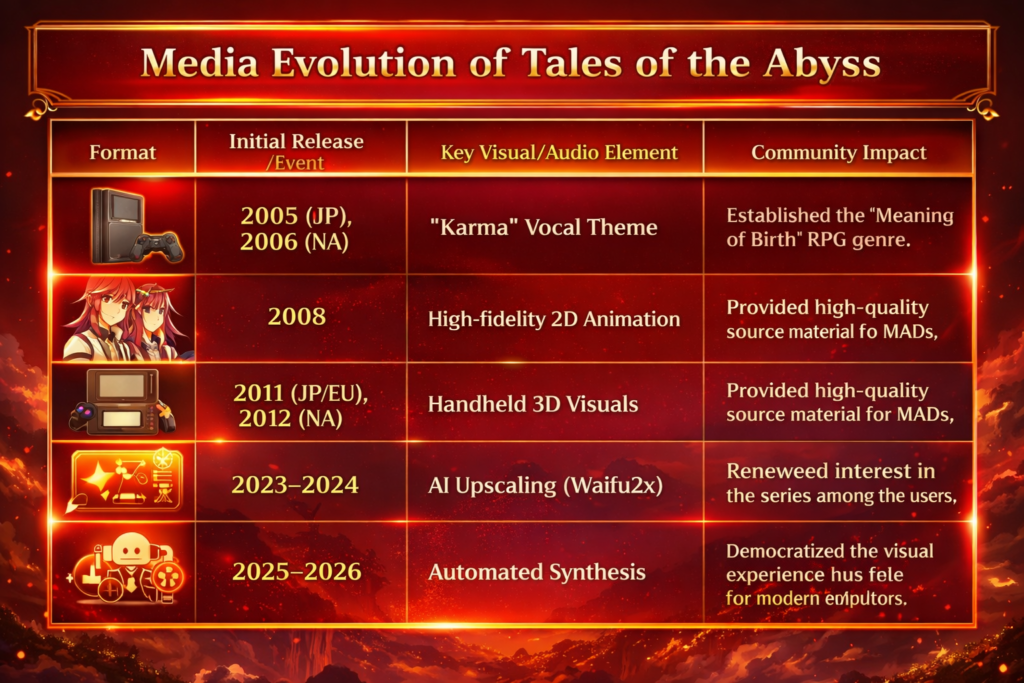
The evolution of these formats highlights a consistent trend: the community’s desire to keep the world of Auldrant relevant through technological adaptation. From the initial release to the latest AI-driven upscaling projects that took over a year to complete, the fan base has consistently pushed the limits of available hardware and software to honor the game’s legacy.
Technical Architecture of AI Video Synthesis Platforms
To understand the mechanism of a “parody generator,” one must examine the specific pipelines used by current AI video models. These platforms are generally divided into video-to-video (V2V), image-to-video (I2V), and text-to-video (T2V) workflows. For the purpose of creating a Tales of the Abyss opening parody, V2V and I2V are the most prominent, as they allow for the preservation of iconic character designs while introducing new stylistic elements.
Video-to-Video and Style Transfer
DomoAI has emerged as a primary tool for “restyling” existing footage. Its “Nano Banana Pro” model is specifically optimized for clean line art and stable colors, which are essential for replicating the aesthetic of character designer Kōsuke Fujishima. The process involves uploading a video—perhaps a recording of a real person acting out a scene or a clip from the original game—and selecting an anime filter. The AI then intelligently analyzes the subjects, actions, and scene details, ensuring that the final animation preserves the original content while giving it a stunning anime vibe. This is particularly useful for parodies that require “consistent actors” and environments across multiple shots, a feat that once required a full animation studio.
Image-to-Video and Cinematic Motion
Platforms like Luma AI’s Dream Machine and Luma Ray 2 provide a different approach by transforming static images into high-quality videos. This is often used for the “establishing shots” common in Tales series openings, such as a slow pan across the city of Baticul or the dramatic reveal of the Tartarus landship. Luma’s “Hand-Painted Aesthetic” recreates the soft textures and brushwork of beloved animation studios, adding 3D-like depth and perspective to what would otherwise be a flat 2D image. Its “Character Reference” feature is a critical advancement, as it allows a character’s identity to remain consistent across different generated clips, solving one of the most persistent issues in AI video creation.
Feature Comparison of Modern AI Animation Tools
| Feature | DomoAI | Agent Opus | Luma Dream Machine | Neolemon |
| Primary Workflow | Video-to-Video | Text-to-Video | Image-to-Video | Character Ref |
| Music Sync | Auto Lip Sync | Beat Detection | Add Audio Feature | Manual Control |
| Consistency | Style Transfer | Asset Integration | RefFrame Editor | Character Turbo |
| Output Quality | Up to 6K | Publish-Ready | 4K Upscale | High-res 2D |
| Special Effects | Background Removal | Speed Lines/Zooms | Cinematic Motion | Action Editor |
Issues and Technical Bottlenecks in AI Parody Production
Despite the sophisticated nature of these tools, the creation of a professional-grade Tales of the Abyss parody is fraught with technical and social challenges. These issues range from the inherent limitations of diffusion models to the ideological resistance within the fan community.
Motion Stability and Visual Artifacts
A primary technical concern is the tendency for AI video models to produce “jitter,” “flickering,” or “glitchy motion”. This occurs because most models generate video frame-by-frame, and without strong temporal consistency, the AI may change small details like hair length or eye color between frames. Creators have attempted to solve this using “guided keyframes” and “internal smoothing” to keep the motion stable. Furthermore, some models suffer from “lighting and color drift,” where a shot starts with one color palette and slowly changes brightness or saturation over the sequence. This is particularly problematic for parodies that aim to mimic the very specific, high-contrast lighting of a Namco Tales opening.
The Conflict of Consistency and Character Integrity
Maintaining character consistency is perhaps the greatest hurdle for an AI generator trying to handle a cast as diverse as that of Tales of the Abyss. For example, the protagonist Luke fon Fabre undergoes a significant visual change midway through the game—cutting his long hair to symbolize his personal growth. An AI generator must be able to distinguish between these “long hair” and “short hair” versions of the character without blending them into a generic mess. To address this, tools like Neolemon use a “Character Turbo” interface where users describe the character’s appearance and outfit separately from the action and background, ensuring the model remains “on-brand”.
Community Sentiment and Ethical Barriers
Beyond technical glitches, the use of AI in the Tales series fandom is a polarizing topic. The official community on Reddit, r/tales, has explicitly banned AI-generated art under its “Rule 9”. This policy is a response to the perceived “low-effort” nature of AI posts and a desire to protect human artists who spend years honing their craft. This creates a situation where creators of AI parodies must find alternative venues to share their work, as the core fandom often views AI as a “detriment” to the series’ creative spirit. The tension is exacerbated by the fact that the original game’s themes—such as the creation of “replicas” that are viewed as soulless copies of real humans—ironically mirror the real-world debate over AI-generated content.
Latest Reports and YouTube Insights: The “Abridged” Precursor
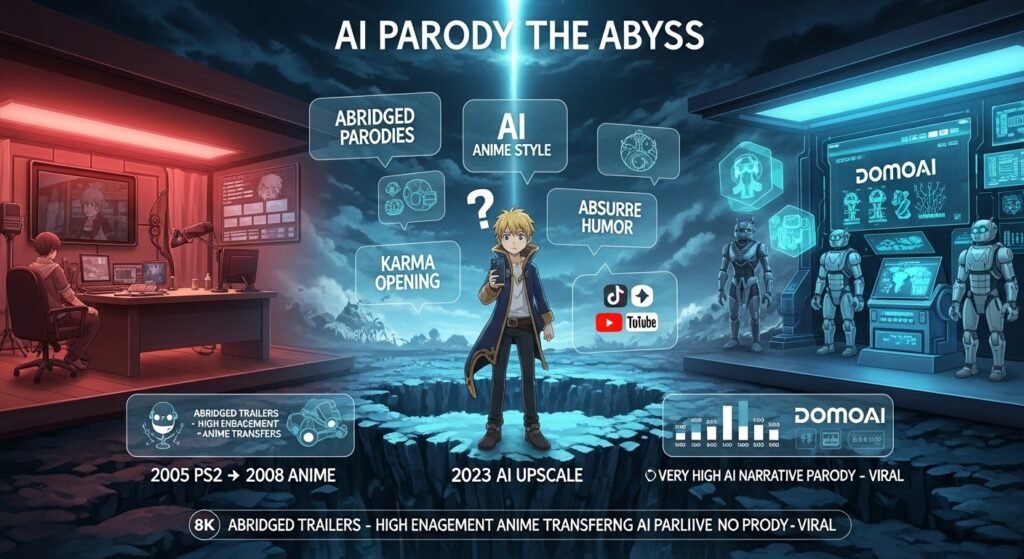
To understand the current state of Tales of the Abyss parodies, one must look at the “Abridged” movement on YouTube, which has set the narrative stage for AI tools. “The Tales Project: Tales of the Abyss Abridged” is a prime example of high-quality fan parody that focuses on character progression and absurdist humor. While this project relies on human voice acting and manual video editing, it utilizes the same tropes that AI generators are now being programmed to automate.
Trends in AI Video Consumption
Data from platforms like Media.io and Monica AI suggest that creators are increasingly looking for “scroll-stopping” content that can be produced quickly. On TikTok and YouTube Shorts, parodies that place heroes in “hilariously unexpected ways”—such as Luke debating whether cats or dogs are better while at the edge of the abyss—are gaining traction. These videos tap into “collective nostalgia” by using the iconic “Karma” opening as a hook, then subverting it with AI-generated dialogue or visual gags.
YouTube Engagement Metrics for Parody Content
| Content Type | Primary Engagement Hook | Average Production Time (AI-Augmented) | Viral Potential |
| Abridged Trailers | Character voice acting | Days to Weeks | High (within fandom) |
| Anime Style Transfers | Visual “Ghibli” or “90s” look | Minutes to Hours | Very High (social media) |
| “Karma” Covers | Musical reinterpretations | Hours | Moderate |
| AI Narrative Parodies | Absurdist juxtaposition | Minutes | High (meme-driven) |
The rise of “DomoAI” as a “rapid prototyping” tool has allowed creators to generate twenty variations of a single parody in a day, significantly increasing the chances of one version going viral. This “shotgun approach” to creativity is a hallmark of the current AI video era, where quantity and iteration often lead to the discovery of high-quality “gems”.
Solutions and Tips for Aspiring Parody Creators
For creators looking to overcome the technical hurdles of AI video synthesis and produce a high-quality Tales of the Abyss parody, several strategic solutions have emerged from the community.
Master the “Anime Opening” Prompt Structure
A successful parody relies on a prompt that understands the “Shonen” action narrative arc. According to workflows established by Agent Opus, a prompt should be broken down beat-by-beat to ensure the AI applies the correct tropes at the right time.
Beat-by-Beat Prompting Strategy:
- The Establishing Shot: Begin with a description of the environment using high-fidelity keywords (e.g., “Open with an enchanted, glowing forest at dusk, ancient mossy trees, mystical aura”).
- The Character Reveal: Use “split-screen” or “silhouette transformations” to introduce the cast. For Tales of the Abyss, mentioning “Kōsuke Fujishima character design” helps the AI lock onto the specific aesthetic.
- The Conflict: Introduce a hint of challenge, often involving a “power-up” or “transformation” scene.
- The Montage: Describe a rapid sequence of shots, such as a “montage of character success moments” or “weapon clashing with particle effects”.
- The Logo Outro: End with a stylized title card (e.g., “End with the Tales of the Abyss logo exploding onto the screen with speed lines”).
Emulator Optimization and Source Quality
The quality of an AI-generated parody is heavily dependent on the quality of the source assets. When capturing footage from the original PS2 game, creators should use emulators like PCSX2 and set the filtering to “Nearest” or “Nearest Neighbour”. This results in “crispy” sprite looks that provide much better data for an AI cartoonizer than the default “Linear” filtering, which causes sprites to meld together and look blurry at high resolutions. For those looking to upscale existing low-resolution footage, tools like “Waifu2x” or the more modern “Z-image turbo” are recommended to enhance the image to 4K before passing it through a style transfer model.
Managing Character Consistency through Reference Frames
One of the most effective solutions for character drift is the use of “reference images” or “character locks”. Platforms like Neolemon allow creators to build a “base” character image in a neutral pose and then use an “Action Editor” to generate different poses and expressions while maintaining the same face and outfit. This “studio-grade” approach ensures that Jade Curtiss looks like Jade Curtiss in every scene, whether he is casting a spell or making a sarcastic remark about the party’s cooking skills.
Conclusion: The Future of Fan-Driven Media
The emergence of AI opening parody generators for titles like Tales of the Abyss signals a new era in fan participation. These tools are not merely about “replacing” traditional animation but about offering a “gateway for expression” that was previously locked behind a high barrier of technical skill. As AI models like Luma’s Ray 3 and Chroma 1.0 continue to advance, the potential for “real-time” and “interactive” parodies grows, where a user could potentially “chat” with an AI-driven character and see them respond with cinematic-quality animation in the style of their favorite game.
While the community remains divided over the ethics and “soul” of AI art, the drive to reimagine these beloved stories in “hilariously unexpected ways” is a testament to the enduring power of the Tales of the Abyss narrative. By blending the existential dread of the Seventh Fonon with the silliness of modern internet culture, creators are ensuring that the world of Auldrant remains a vibrant and evolving digital realm. Whether through a serious HD remaster or a laugh-out-loud parody about pizza, the legacy of Luke fon Fabre and his companions continues to find new life in the age of artificial intelligence.
FAQ’s
It is an AI-powered video creation concept that allows fans to generate parody-style opening videos inspired by Tales of the Abyss using text prompts, images, or existing footage. These tools automate animation, music sync, and cinematic effects to recreate the iconic opening in humorous or creative ways.
Fan-made parody content generally falls under fair use in many regions, especially when it is transformative and non-commercial. However, the original characters and music are copyrighted, so monetization or commercial use may require permission from rights holders.
Popular tools include DomoAI (video-to-video anime style transfer), Luma Dream Machine (image-to-video cinematic motion), Agent Opus (text-to-video workflows), and Neolemon for character consistency. Each platform supports different stages of the parody creation pipeline.