
AI Transformation is a Problem of Governance, Not Technology You bought the enterprise AI licenses. You spun up the cloud infrastructure. You hired the prompt engineers and machine learning architects.
Yet, your AI transformation has stalled. Adoption is fragmented, ROI is flat, and your legal team is losing sleep over potential data breaches.
This is the reality for most enterprises in 2026. The uncomfortable truth is that the bottleneck to scaling artificial intelligence isn’t a lack of computing power, a shortage of data, or inadequate foundation models. The technology works.
The real problem? AI transformation is a problem of governance.
In our experience consulting with enterprise executives, the most successful AI deployments don’t start in the IT department; they start in the boardroom. Without a comprehensive AI governance framework, companies fall victim to “Shadow AI,” regulatory fines, and algorithmic bias.
This guide breaks down why tech-first AI fails and provides a definitive, boardroom-ready blueprint for implementing scalable AI governance.
The Core Misconception: Why Tech-First AI Fails
For the past few years, the corporate mandate was simple: Deploy AI at all costs. Companies threw millions at Large Language Models (LLMs) and Generative AI tools, treating them like standard SaaS rollouts.
But AI is not standard software. It is non-deterministic. It evolves, hallucinates, and makes autonomous decisions.
According to McKinsey & Company’s State of AI reports, while generative AI has reached breakout adoption levels, realizing measurable, enterprise-wide value remains a massive hurdle. Why? Because deploying AI without governance is like building a Ferrari without brakes. You don’t dare drive it fast.
When companies take a “tech-first, governance-later” approach, three things happen:
- Pilots purgatory: AI initiatives remain stuck in the testing phase because compliance teams won’t approve widespread deployment.
- Negative ROI: Massive cloud and compute costs are incurred without operational integration.
- Unseen Liabilities: Employees start using AI tools on their own, bypassing IT protocols entirely.
Key Takeaway: If your C-suite is asking, “Why isn’t our AI strategy working?” the answer rarely lies in your tech stack. It lies in your lack of internal oversight.
The Rise of Shadow AI in the Enterprise
If you think your company isn’t using AI, you are wrong. Your employees are.
Shadow AI occurs when employees use unsanctioned, unvetted consumer AI tools to do their jobs. A report from MIT Sloan Management Review explicitly highlights the compounding risks of Shadow AI. Employees are feeding proprietary code, sensitive client data, and confidential financials into public models to save time.
We all remember the infamous Samsung incident where engineers accidentally leaked proprietary source code by feeding it into a public ChatGPT interface. That wasn’t a technology failure; it was a catastrophic failure of governance.
The 4 Pillars of a Robust AI Governance Framework
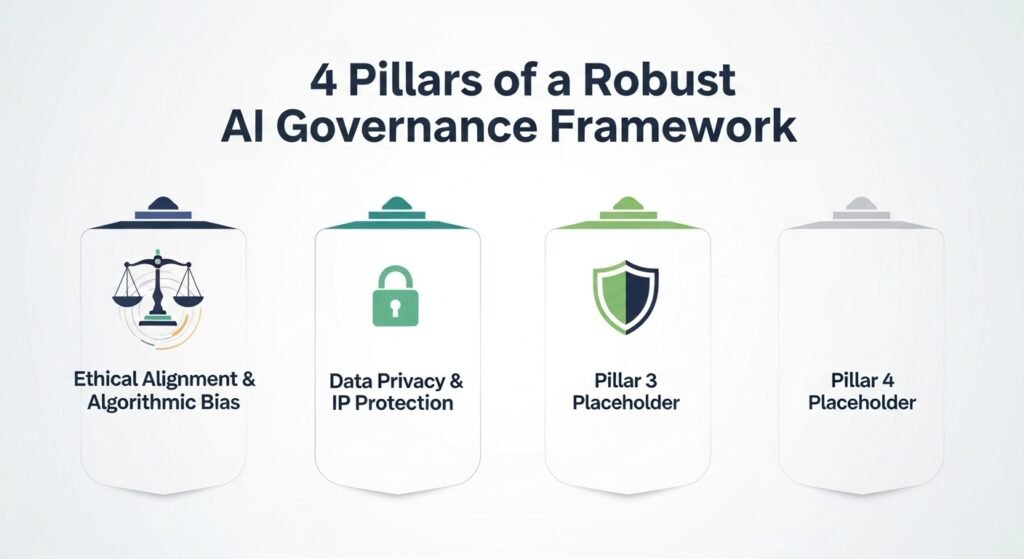
To move from chaos to controlled scale, enterprises must adopt a structured approach. Based on frameworks like Gartner’s AI Trust, Risk and Security Management (AI TRiSM) and the World Economic Forum’s AI Governance Alliance, we have distilled enterprise AI governance into four non-negotiable pillars.
1. Ethical Alignment & Algorithmic Bias
AI models are only as unbiased as the data they are trained on. If your HR department uses an AI screening tool trained on historically biased data, you are automating discrimination at scale.
IBM’s Institute for Business Value emphasizes “AI ethics in action” as a core differentiator for trusted brands.
- The Governance Action: Implement mandatory bias-testing protocols before any model goes into production.
- The Goal: Ensure AI decisions align with your corporate values and do not disenfranchise protected groups.
2. Data Privacy & IP Protection
When an employee prompts an LLM, where does that data go? Does it train the vendor’s future models?
Data privacy is the most immediate risk of AI transformation. Your governance framework must dictate strict “ring-fencing” of corporate data.
- The Governance Action: Transition to private cloud environments, localized models, or negotiate zero-data-retention agreements with AI vendors.
- The Goal: Zero leakage of Intellectual Property (IP) and strict adherence to global privacy laws like GDPR.
3. Regulatory Compliance & Auditability
We are no longer in the Wild West of AI. The EU Artificial Intelligence Act is actively enforcing strict penalties for non-compliance, categorizing AI systems by risk levels. Similarly, in the US, the NIST Artificial Intelligence Risk Management Framework (AI RMF) has become the gold standard for compliance.
- The Governance Action: Maintain an active registry of all AI models used within the company. Document their purpose, data sources, and risk categorization.
- The Goal: When regulators or auditors knock on your door, you must be able to explain how and why your AI made a specific decision.
4. Human-in-the-Loop (HITL) Accountability
Who gets fired when the AI makes a million-dollar mistake?
AI should augment human intelligence, not abdicate human responsibility. Complete autonomous decision-making in high-stakes environments (finance, healthcare, legal) is a massive liability.
- The Governance Action: Define clear “Human-in-the-Loop” checkpoints. AI can draft the contract, but a human lawyer must sign it. AI can flag the fraudulent transaction, but a human analyst must confirm it.
- The Goal: Establish clear lines of legal and corporate accountability for AI outputs.
How to Build Your AI Governance Council
You cannot delegate AI governance solely to the IT department. IT builds the engine; the business must steer the car.
According to Harvard Business Review’s guide for boards on AI Governance, oversight requires a cross-functional task force. You must establish an AI Governance Council to review, approve, and monitor AI deployments.
Step-by-Step Implementation:
- Appoint a Leader: Designate a Chief AI Officer (CAIO) or empower your Chief Data Officer to lead the council.
- Draft the Charter: Write a definitive corporate policy on acceptable AI use.
- Build the Review Process: Create a frictionless intake form where employees can request new AI tools, which the council then evaluates against the 4 Pillars.
The Ideal AI Governance Council Structure
- The Chair: Chief Data Officer or Chief AI Officer
- Legal & Compliance: General Counsel / Chief Compliance Officer (Focus: EU AI Act, IP risk)
- Technology: CIO / VP of Engineering (Focus: Architecture, security)
- Human Resources: CHRO (Focus: Workforce impact, bias in HR tools)
- Business Units: VP of Operations / Sales (Focus: Practical ROI, adoption)
The ROI of Governance: Speed Through Safety
There is a common misconception among CEOs highlighted frequently in PwC’s Annual Global CEO Surveys that governance slows down innovation. They fear that adding red tape will cause them to lose the AI race to more agile competitors.
The exact opposite is true.
Think of AI governance not as a handbrake, but as a seatbelt. When employees know there is a clear, safe, and sanctioned framework for using AI, they experiment more. When the legal team is confident that data is ring-fenced, they approve deployments faster.
Firms surveyed by Forrester with mature AI governance practices report higher ROI, faster time-to-market for AI products, and vastly lower incident rates of data breaches.
Governance removes the paralyzing fear of the unknown. It transforms AI from a localized, rogue experiment into a scalable, enterprise-wide capability.
Frequently Asked Questions (FAQ)
What is AI TRiSM? AI TRiSM stands for AI Trust, Risk, and Security Management. It is a framework coined by Gartner that outlines the necessary capabilities to ensure AI model reliability, fairness, reliability, and privacy.
Who should own AI governance in a company? AI governance should not be siloed in IT. It requires a cross-functional council typically led by a Chief Data Officer, Chief AI Officer, or Chief Risk Officer, with mandatory representation from Legal, HR, and IT.
Why do so many enterprise AI projects fail? Most fail due to a lack of alignment between technology and business strategy, compounded by compliance fears. Without governance, projects get stuck in “pilot purgatory” because legal and security teams block full-scale deployment to prevent data risks.
How does the EU AI Act affect my business? If you do business in Europe, the EU AI Act mandates strict risk assessments, transparency requirements, and human oversight for AI systems. Non-compliance can result in massive fines, forcing global enterprises to adopt these standards universally.
Conclusion: Take Control of Your AI Transformation
AI transformation is no longer a technology challenge. The models are ready. The cloud infrastructure is ready.
The question is: Is your leadership ready?
If you are struggling to scale AI, stop looking at your tech stack and start looking at your policies. By implementing a robust AI governance framework anchored in ethical alignment, data privacy, regulatory compliance, and human accountability you eliminate the risks of Shadow AI and build the foundation for sustainable, high-speed innovation.