
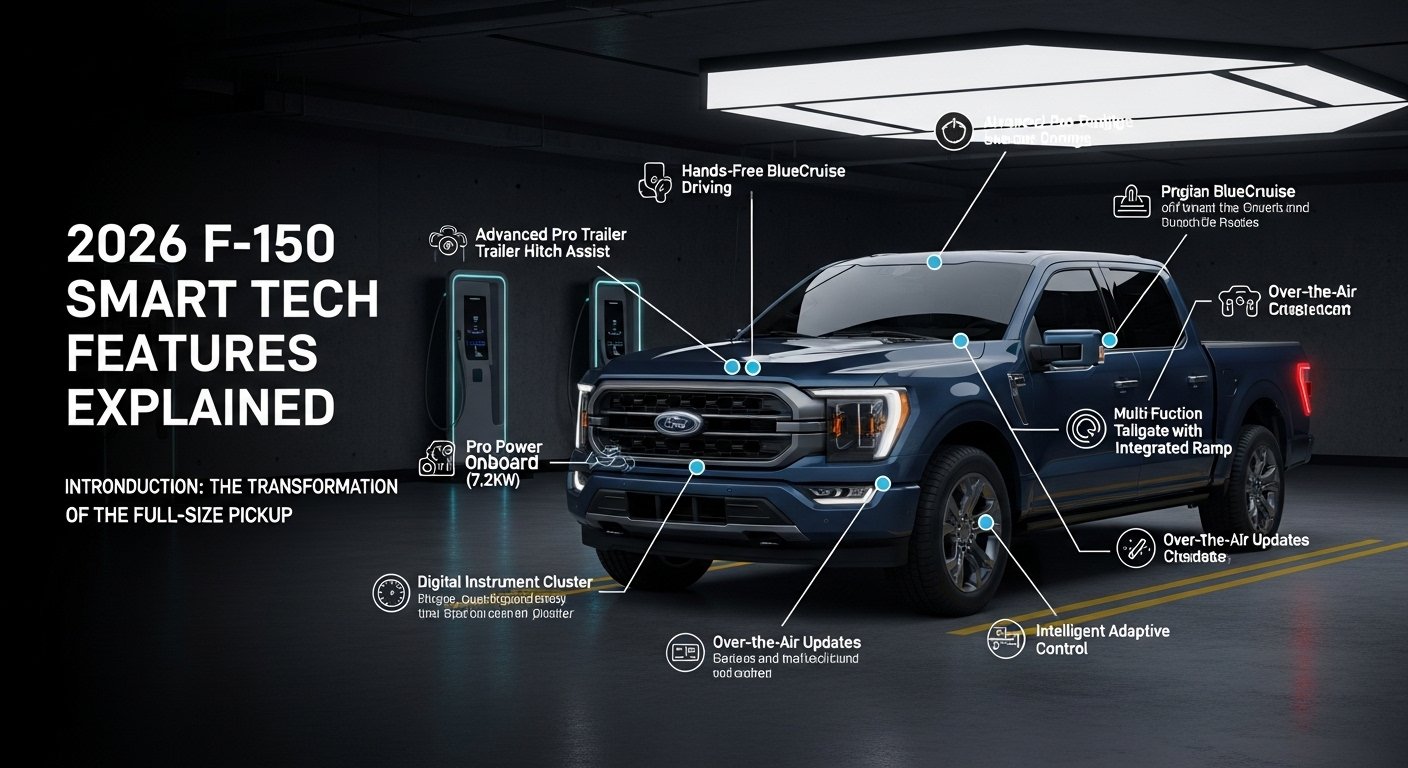
Introduction: The Transformation of the Full-Size Pickup
The automotive industry has reached a critical juncture where the traditional metrics of vehicle value horsepower, torque, and payload—are being augmented, and in some cases superseded, by the efficacy of a vehicle’s silicon and software architecture. The 2026 Ford F-150 stands as a primary exemplar of this transition, representing a shift from a purely mechanical workhorse to a sophisticated, software-defined platform. As the F-Series enters the latter half of its fourteenth generation, the focus for the 2026 model year is not on a radical structural overhaul, but on a deep refinement of the technological ecosystem that defines the user experience. This evolution is driven by the necessity to provide a mobile command center that serves a dual purpose: a high-efficiency tool for commercial enterprise and a technologically seamless environment for personal lifestyle use.
The significance of these smart tech features lies in their ability to mitigate the cognitive load of driving and to expand the utility of the vehicle beyond simple transit. In 2026, the F-150 integrates the “Ford Digital Experience,” a high-bandwidth connectivity suite that leverages 5G networks to provide real-time data processing and an app-centric infotainment interface. Furthermore, the refinement of semi-autonomous driving through BlueCruise 1.4 marks a significant step toward reducing driver fatigue during long-haul highway travel. For the commercial operator, the integration of intelligent utility features—such as Pro Power Onboard and Onboard Scales—transforms the truck bed into a precision instrument capable of managing electrical loads and cargo weight with digital accuracy.
The Infotainment Paradigm Shift: From SYNC to the Ford Digital Experience
The most visible technological advancement in the 2026 Ford F-150 is the fundamental change in its infotainment architecture. While previous iterations relied on the SYNC series, the 2026 model year sees a broader rollout of the “Ford Digital Experience,” a system developed in collaboration with Google to provide a more responsive and customizable interface.
Architectural Foundations and 5G Connectivity
The Ford Digital Experience is built upon a decoupled software architecture, specifically utilizing the Android Automotive Operating System (AAOS). This shift allows the vehicle’s primary interface to function with the speed and flexibility of a modern mobile device. The system is supported by a high-performance central processing unit (CPU) and a dedicated graphics processing unit (GPU), enabling smooth animations, faster response times, and the capability to run intensive applications such as in-car gaming and high-definition video streaming when the vehicle is in a parked state.
Connectivity is anchored by an integrated 5G LTE modem, which provides the high-frequency bandwidth required for the system’s cloud-based features. This modem facilitates the Ford Connectivity Package, which offers one year of included service to support unlimited Wi-Fi for up to ten devices, real-time map updates, and the streaming of high-bitrate audio and video content. The transition to 5G is a critical component of Ford’s long-term strategy, as it ensures the vehicle can handle the increasing volume of data required for sophisticated Over-the-Air (OTA) updates and real-time vehicle-to-everything (V2X) communications.
Ecosystem Integration: Google, Amazon, and Apple
One of the primary goals of the Ford Digital Experience is to minimize the friction between a user’s personal digital life and their vehicle’s interface. By integrating Google apps and services natively into the dashboard, Ford allows users to access Google Maps for real-time traffic and automatic rerouting, Google Assistant for conversational voice control of cabin functions, and the Google Play Store to download third-party applications directly to the truck.
Despite the deep integration with the Google ecosystem, Ford has maintained a platform-agnostic approach. The system remains fully compatible with wireless Apple CarPlay and Android Auto, allowing users who prefer smartphone projection to utilize those interfaces seamlessly alongside native vehicle apps. Furthermore, Amazon Alexa is built into the system, providing an alternative voice assistant for users who utilize the Amazon smart home ecosystem.
| Infotainment Feature | Specification / Capability | Availability |
| Operating System | Android Automotive OS (Android 12) | Standard on Select Models |
| Center Touchscreen | 12-inch or 13.2-inch Capacitive Display | Standard Across Lineup |
| Connectivity | 5G LTE Modem with Wi-Fi Hotspot | Standard with FordPass |
| Voice Control | Google Assistant / Amazon Alexa | Integrated Native Support |
| Smartphone Link | Wireless Apple CarPlay / Android Auto | Standard |
| OTA Updates | Full Vehicle System Software Capability | Standard |
Advanced Driver Assistance Systems: The Evolution of BlueCruise
In the realm of semi-autonomous driving, the 2026 F-150 leverages Ford BlueCruise 1.4, which represents a maturation of the manufacturer’s “hands-off, eyes-on” highway technology. The system is designed to handle the most taxing portions of highway driving, such as long stretches of interstate and heavy stop-and-go traffic, thereby reducing driver fatigue.
Sensor Fusion and the Direct Driver Monitoring System
BlueCruise operates through a robust sensor fusion strategy, combining data from high-resolution exterior cameras, long-range radar, and ultrasonic sensors. These sensors work in concert to monitor lane markings, maintain a safe distance from other vehicles, and manage the truck’s acceleration and braking.
A critical component of this technology is the Direct Driver Monitoring System (DDMS). This system utilizes an infrared camera mounted on the steering column to track the driver’s eye gaze and head position. Because the system is infrared-based, it can function effectively even when the driver is wearing sunglasses or in low-light conditions. If the DDMS detects that the driver’s attention has drifted away from the road for a predetermined period, it initiates a series of graduated alerts—visual prompts on the digital cluster followed by audible warnings—to ensure the driver resumes manual control or refocuses on the environment.
Functional Refinements in Version 1.4
BlueCruise 1.4 introduces several key features that move the experience toward a more human-like driving style. These enhancements are the result of significant data analysis from Ford’s fleet of connected vehicles, leading to more refined software logic.
- Extended Hands-Free Engagement: Through optimized software code, version 1.4 can remain in hands-free mode for durations up to eight times longer than the initial 1.0 release. This is achieved by improving the system’s ability to handle tighter highway curves and varying lighting conditions without disengaging.
- In-Lane Repositioning: To address the psychological discomfort of driving alongside large commercial vehicles, the system will subtly shift the F-150 within its lane, moving it away from a semi-truck in an adjacent lane while still maintaining a safe distance from the other lane marking.
- Lane Change Assist: When the driver taps the turn signal, the system evaluates the surrounding traffic using rear-facing radar. If the path is clear, the truck will autonomously steer itself into the adjacent lane while maintaining its set speed.
- Automatic Lane Change: In certain scenarios, the software can identify when the vehicle is behind a slower-moving car and autonomously initiate a lane change to overtake, provided the highway conditions meet safety parameters.
| BlueCruise Version | Primary Improvements | Data Connectivity Requirement |
| Version 1.0 | Baseline Hands-Free Highway Driving | Connected Maps via FordPass |
| Version 1.2 | Introduction of Lane Change Assist | High-Speed Data Plan |
| Version 1.3 | Improved Cornering and Lane Stability | 4G/5G Connectivity |
| Version 1.4 | 8x Engagement Duration, Smoother Control | 5G/Cloud Sync |
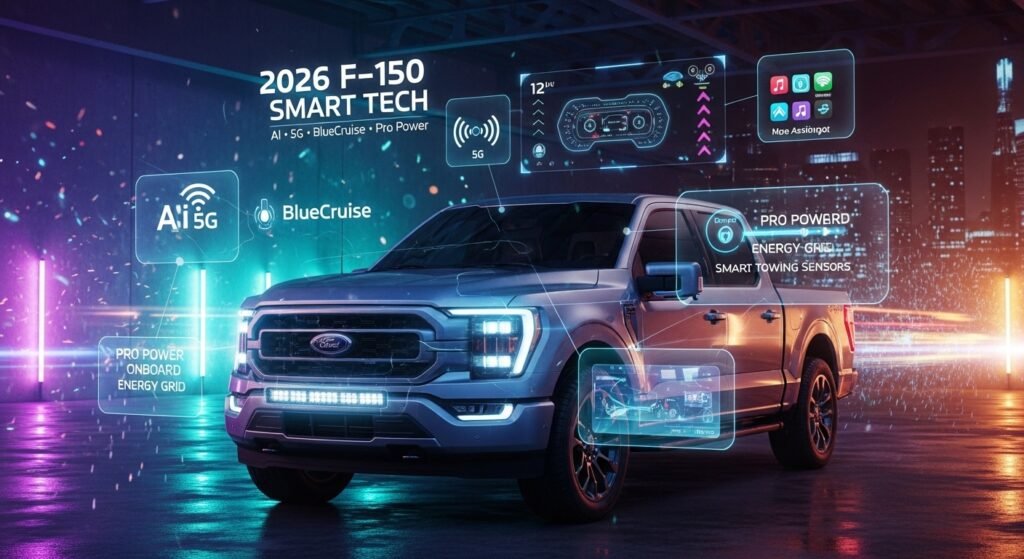
The Intelligent Workspace: Smart Utility Features in the Truck Bed
The cargo bed of the 2026 Ford F-150 has evolved from a simple containment area into a digitally managed workspace. Ford’s engineers have focused on integrating electrical power and weight sensors to maximize the truck’s utility on the job site and in recreational settings.
Pro Power Onboard: A Mobile Electrical Grid
The Pro Power Onboard system is a hallmark of the F-150’s smart tech suite, essentially turning the vehicle into a mobile generator. This system utilizes an inverter to convert power from the vehicle’s powertrain—whether gas or hybrid—into exportable AC electricity through outlets located in the truck bed and cabin.
The power output is tiered based on the vehicle’s configuration. The base 2.0 kW system, available on several gas engines, is sufficient for running smaller power tools, chargers, or a tailgate entertainment setup. The PowerBoost Hybrid model steps this up significantly, offering a standard 2.4 kW output or an available 7.2 kW system. The 7.2 kW variant is capable of powering a framing crew’s entire tool set for a full workday or running essential home appliances during a power outage. For the all-electric F-150 Lightning, the output reaches 9.6 kW, distributed across 11 outlets, including the cabin and the front trunk (frunk).
Precision Loading with Onboard Scales and Smart Hitch
To ensure safety and compliance with payload limits, the 2026 F-150 features Onboard Scales. This system uses height sensors integrated into the suspension to calculate the weight of the cargo currently in the bed. The real-time weight data is displayed on the center touchscreen and through the FordPass app, allowing owners to know exactly how close they are to the vehicle’s maximum payload capacity.
The Smart Hitch takes this logic further by measuring the tongue weight of a connected trailer. Proper tongue weight is essential for preventing trailer sway and ensuring optimal braking performance. The system provides visual guidance on the center screen, indicating whether the load in the trailer should be shifted forward or backward to achieve the correct balance. Interestingly, the truck can also communicate this data through the LED taillights, which act like a progress bar, filling up as weight is added.
The Pro Access Tailgate: Engineering for Accessibility
A significant mechanical and electronic innovation for 2026 is the Pro Access Tailgate. Recognizing that dropping a traditional tailgate is often impossible when a trailer is attached, Ford developed a multi-function gate with an integrated side-hinged door. This door opens from the driver’s side and can swing open to 37, 70, or a full 100 degrees.
The smart aspect of this design includes obstacle detection and a “Tailgate Down” camera. When the tailgate is in the traditional lowered position, the camera system provides a full 360-degree view around the vehicle, ensuring that parking sensors remain active even if the tailgate is obscuring the primary rear-view camera. The swing-out door allows the driver to stand 19 inches closer to the bed, making it much easier to reach items stored deep in the cargo area without needing to crawl over the gate.
| Utility Technology | Max Output / Capability | Key Benefit |
| Pro Power Onboard | 9.6 kW (Lightning) / 7.2 kW (Hybrid) | Powers tools, homes, or campsites |
| Onboard Scales | Real-time suspension-based weighing | Prevents overloading and axle stress |
| Smart Hitch | Tongue weight measurement | Optimizes trailer balance and safety |
| Pro Access Tailgate | 100-degree swing door | Closer reach to cargo while hitched |
| Mega Power Frunk | 400 liters / 2.4 kW export | Secure, powered storage for EVs |
Intelligent Towing Ecosystem: Sensor-Assisted Maneuvering
Towing represents the most technically demanding task for many F-150 owners. For the 2026 model year, Ford has consolidated its towing assist features into a cohesive, user-friendly digital ecosystem that relies heavily on computer vision and ultrasonic sensing.
Pro Trailer Hitch Assist and Backup Assist
The process of aligning a hitch ball with a trailer coupler is simplified through Pro Trailer Hitch Assist. This system uses the rear camera and radar to identify the trailer’s coupler. Once initiated, the truck autonomously controls the steering, throttle, and braking to back the F-150 into the perfect position for a secure connection. This eliminates the need for a second person to act as a spotter and significantly reduces the time required to hitch up.
Once the trailer is connected, Pro Trailer Backup Assist becomes the primary tool for maneuvering. Instead of the driver needing to counter-steer the wheel—a process that is notoriously counter-intuitive—they simply turn a knob on the dashboard in the direction they want the trailer to go. The truck’s onboard computer handles the steering wheel inputs required to achieve that angle, and the system can even remember the specific dimensions of multiple trailers for instant recall.
Digital Safety and Awareness Tools
The smart tech suite for towing includes several passive and active monitoring tools:
- BLIS with Trailer Coverage: The Blind Spot Information System is calibrated to the length of the trailer. If the driver initiates a turn signal, the system uses its rear-quarter radar sensors to detect if a vehicle is in the blind spot of the trailer, providing an alert in the side-view mirror.
- Trailer TPMS and Camera Integration: Higher trims offer the ability to integrate wireless tire pressure monitoring sensors for the trailer directly into the truck’s digital cluster. Additionally, a customer-placed camera can be mounted on the rear of the trailer, with the feed transmitted directly to the 12-inch center display.
- Trailer Sway Control: Utilizing the truck’s electronic stability control sensors, this software can detect the onset of trailer sway and apply individual truck brakes or reduce engine power to stabilize the vehicle and trailer combination.
The Digital Cockpit: Screens, HUDs, and Personalization
The interior of the 2026 F-150 is centered around a “Digital Command Center” philosophy, where every screen is designed to provide high-resolution, context-aware information to the driver.
Standard 12-Inch Displays and Digital Clusters
For 2026, Ford has standardized the 12-inch capacitive center touchscreen across almost the entire lineup, replacing the smaller units found in previous years. This screen features swipe functionality and split-screen capabilities, allowing the driver to view navigation and media or vehicle data simultaneously.
In front of the driver, the traditional analog gauge cluster has been replaced by a fully digital productivity screen. This display is highly customizable, allowing the driver to prioritize different data clusters—such as off-road pitch and roll, towing data, or navigation directions—depending on the current drive mode. On models equipped with the Ford Digital Experience, this cluster can even display maps directly from a projected smartphone via Apple CarPlay or Android Auto, a feature Ford calls “two-screen projection”.
The Augmented View: Head-Up Display (HUD)
Available on premium trims like the King Ranch, Platinum, and Raptor, the Head-Up Display projects critical information directly onto the windshield. This allows the driver to monitor their speed, the current speed limit, and active driver-assistance prompts without taking their eyes off the road. The HUD is designed to be visible in all lighting conditions and can even display specific off-road or towing data when those modes are active.
| Interior Tech Feature | Trim Level Availability | Primary Benefit |
| 12-inch Center Screen | Standard on XL and above | Unified control hub for all vehicle functions |
| 12-inch Digital Cluster | Standard on Lariat and above | High-resolution, customizable driver data |
| Head-Up Display (HUD) | Platinum, King Ranch, Raptor | Eyes-on-road safety for speed and navigation |
| B&O Sound System | Standard on Lariat and above | Premium 8 or 18-speaker immersive audio |
| Wireless Charging Pad | Standard on Lariat and above | Cord-free device power and connectivity |
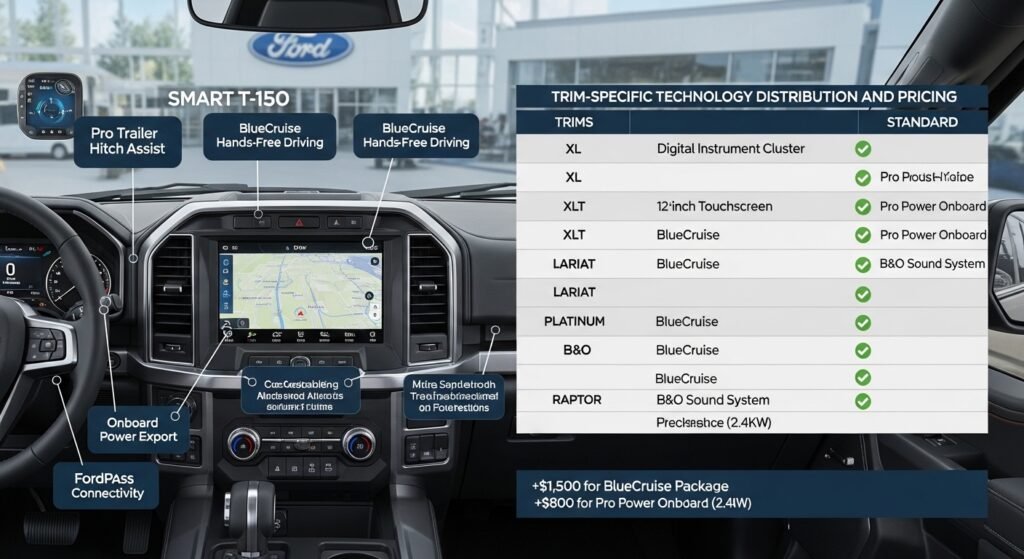
Trim-Specific Technology Distribution and Pricing
The 2026 F-150 lineup is strategically tiered to ensure that both value-conscious fleet buyers and luxury-focused consumers can access the appropriate level of technology.
Entry-Level Trims: XL and STX
The XL (MSRP starting at $39,330) is the foundational model, now featuring standard LED headlamps and a 12-inch SYNC 4 display. The STX (starting at $41,855) adds the Sport Appearance package and unique cloth seating. Both trims include Ford Co-Pilot360 2.0, providing essential safety features like pre-collision assist and blind-spot monitoring.
Mid-Range and Off-Road: XLT and Tremor
The XLT (starting at $44,695) is a popular choice for personal use, adding features like Zone Lighting and the availability of a 360-degree camera. The Tremor (starting at $64,915) is built for serious off-roading, incorporating Trail Control—a low-speed cruise control for trails—and Trail Turn Assist, which can brake the inside rear wheel to tighten the truck’s turning radius on narrow paths.
High Luxury: Lariat, King Ranch, and Platinum
The Lariat (starting at $59,560) introduces heated and ventilated leather seating, the B&O sound system, and a 12-inch digital cluster. King Ranch (starting at $65,825) and Platinum (starting at $68,800) are the luxury flagships, offering BlueCruise, the Head-Up Display, and the Pro Access Tailgate as standard equipment.
High-Performance: Raptor and Raptor R
The Raptor (starting at $79,005) utilizes specialized Fox Live Valve shocks and a High-Output 3.5L EcoBoost V6. The Raptor R adds a monstrous 720-hp supercharged V8 and specialized software for high-speed desert running.
| Trim Level | Starting MSRP | Key Smart Tech Inclusion |
| XL | $39,330 | 12-inch screen, SYNC 4, Co-Pilot360 |
| STX | $41,855 | Unique Digital Cluster Themes, Sport Cloth |
| XLT | $44,695 | Zone Lighting, Optional 360-degree Camera |
| Lariat | $59,560 | B&O Sound, Wireless Charging, Leather |
| Tremor | $64,915 | Trail Control, 1-Pedal Drive, Rock Crawl |
| King Ranch | $65,825 | BlueCruise, HUD, Pro Access Tailgate |
| Platinum | $68,800 | Multi-Contour Seats, Premium Connectivity |
| Raptor | $79,005 | Fox Live Valve Electronics, Terrain Management |
Troubleshooting and Technical Resilience
As the F-150 becomes more reliant on software and electronic sensors, understanding how to maintain and troubleshoot these systems is vital for long-term ownership.
Resolving Connectivity and Infotainment Issues
One of the most frequent challenges for modern vehicle owners is intermittent smartphone connectivity. If the wireless Apple CarPlay or Android Auto fails to launch, Ford’s service technical bulletins recommend the following sequence :
- Module Reset: Hold the power and “seek right” buttons on the physical dash for five seconds to reboot the SYNC module without erasing data.
- Key Cycle: Turn the vehicle off, open and lock the driver’s door, and wait at least two minutes for the onboard computers to fully shut down before restarting.
- Master Reset: If software glitches persist, a “Master Reset” can be performed through the vehicle settings. This will return the system to factory defaults and is often necessary after a major OTA update if the system feels sluggish.
Battery Management and “Deep Sleep” Mode
The F-150’s connectivity features—such as FordPass—create a constant parasitic draw on the 12-volt battery. If the truck is not driven for several days, the Battery Management System (BMS) may enter “Deep Sleep” mode to ensure there is enough power left to start the engine. In this state, remote features like FordPass locking or the Wi-Fi hotspot may be disabled. Owners who primarily take short trips (under 15 minutes) may find that their battery doesn’t receive enough charge to satisfy the high demand of the truck’s smart features, which may necessitate an occasional trickle charge or longer highway drives to maintain battery health.
Transmission Software Logic
The 10-speed automatic transmission in the 2026 F-150 utilizes “adaptive learning” software that adjusts shift timing based on the owner’s driving style. If the truck begins to exhibit harsh shifting, it is often not a mechanical failure but a software calibration issue. Service technicians can “clear the adaptive tables” using the Ford diagnostic tool, allowing the transmission to restart its learning process from a neutral state, which frequently resolves shifting complaints.
Competitive Landscape: The Full-Size Technology Race
To fully appreciate the 2026 F-150’s tech suite, it must be compared to its primary rivals: the Ram 1500 and the Chevrolet Silverado 1500.
Ford BlueCruise vs. Chevrolet Super Cruise
Both Ford and Chevrolet offer industry-leading hands-free systems. Chevrolet’s “Super Cruise” has a notable advantage in that it can be used while towing a trailer on select roads. Ford’s BlueCruise 1.4 focuses more on “human-like” behavior, such as in-lane repositioning and smoother handling of curves. Both systems are top-rated by Consumer Reports, but Ford’s system is often praised for its superior driver-attention monitoring through its infrared camera setup.
Utility and Power Solutions
Ford maintains a clear lead in the “utility tech” space. Neither Ram nor Chevrolet offers a system comparable to Pro Power Onboard in terms of total exportable wattage. While Chevrolet offers the “Multi-Flex” tailgate and Ram has a multi-function swing-away gate, Ford’s Pro Access Tailgate is uniquely engineered to provide the closest reach into the bed while hitched to a trailer.
Infotainment and Interfaces
The Ram 1500 is often considered the segment leader in interior material quality and aesthetics, offering a portrait-oriented 14.5-inch screen. However, Ford’s transition to the Android-based Digital Experience provides a more robust app ecosystem and faster processing speeds compared to the Uconnect 5 system found in the Ram.
| Specification | 2026 Ford F-150 | 2026 Ram 1500 | 2026 Chevy Silverado |
| Max Towing | 13,500 lbs | 11,610 lbs | 13,300 lbs |
| Hands-Free Driving | BlueCruise (v1.4) | None (Active Drive only) | Super Cruise |
| Exportable Power | Up to 9.6 kW | None Equivalent | Up to 400W (basic) |
| App Ecosystem | Google Play Integrated | Uconnect Store | Google Built-In |
| Tailgate Type | Pro Access (Swing/Drop) | Multi-Function (Barn/Drop) | Multi-Flex (6-Position) |
Conclusion: The Integrated Future of the F-Series
The 2026 Ford F-150 demonstrates that the future of the American pickup truck is defined by its ability to merge rugged mechanical capability with high-level digital intelligence. The integration of the Ford Digital Experience and the refinement of BlueCruise 1.4 move the vehicle toward a future where the truck acts as an active partner in the driving task, rather than just a passive tool.
For the user, this means a significant increase in daily productivity and safety. Features like Pro Power Onboard and Onboard Scales eliminate much of the guesswork associated with heavy-duty work, while the towing assist ecosystem democratizes complex maneuvers that once required years of experience.
Ultimately, the smart tech features of the 2026 F-150 are designed to provide a vehicle that is not just “Built Ford Tough,” but “Built Ford Smart.” As the truck continues to receive Over-the-Air updates throughout its life, it will likely continue to evolve, gaining new capabilities and refinements that will keep it at the forefront of the highly competitive full-size truck market.